

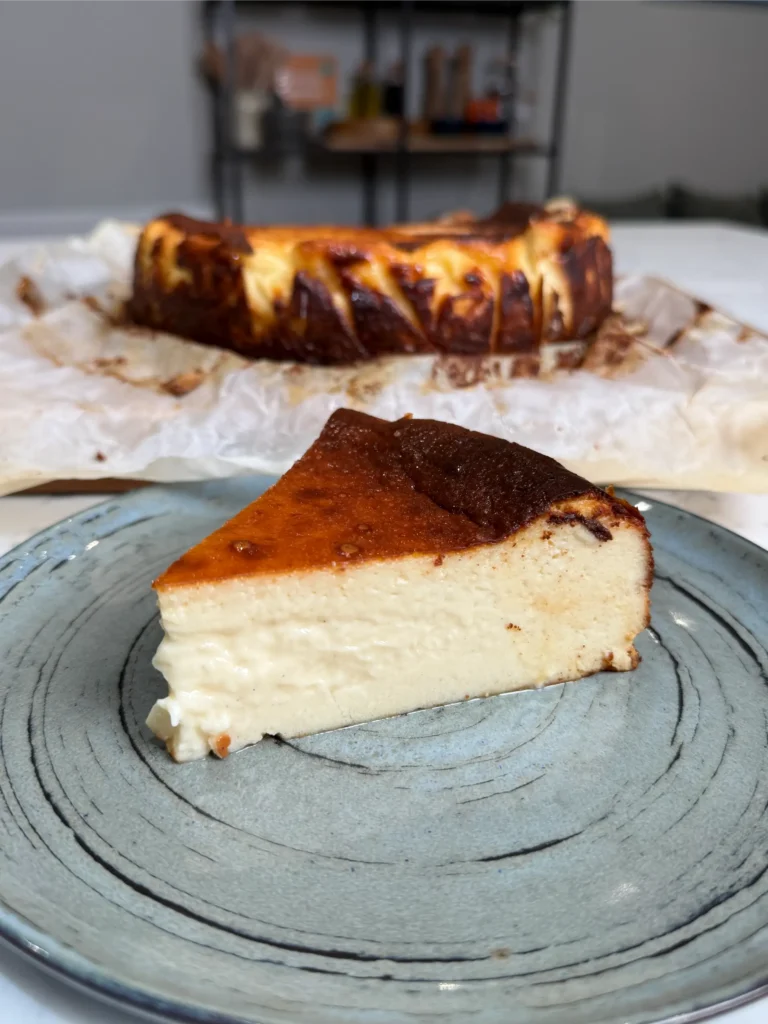
Basque Cheesecake
This might just be my favourite cheesecake of all time.
No biscuit base. No water bath. No complicated techniques. Just a handful of ingredients transformed into something that feels genuinely special.
I first fell in love with Basque cheesecake during a recent trip to San Sebastián. Everywhere you turn, there are pintxos bars, incredible seafood, and some of the best food you’ll ever eat, but one thing that kept appearing again and again was Basque cheesecake. Deeply caramelised on top, impossibly creamy in the middle, and somehow both rustic and elegant at the same time.
After trying several versions whilst I was there, I knew I had to recreate it at home.
The beauty of Basque cheesecake is that it’s deliberately imperfect. The parchment is crumpled. The top looks almost burnt. The centre wobbles alarmingly when it comes out of the oven. Every instinct tells you something has gone wrong.
That’s exactly when you know you’ve nailed it.
Basque Cheesecake
Rich, creamy and beautifully caramelised, this San Sebastián-inspired Basque cheesecake delivers maximum flavour with surprisingly little effort.
No biscuit base. No fuss. Just silky cheesecake perfection.
What is Basque cheesecake?
Basque cheesecake originated in the Basque region of northern Spain, most famously at a restaurant called La Viña in San Sebastián.
Unlike traditional cheesecakes, which aim for a perfectly smooth pale finish, Basque cheesecake embraces contrast.
The top is intentionally baked until dark and deeply caramelised.
The centre remains soft, creamy and almost custard-like.
The edges become slightly firmer and richer.
The result is a cheesecake with incredible depth of flavour and texture.
It’s less polished than a classic New York cheesecake, but arguably more interesting.
Why the burnt top matters
The dark top isn’t a mistake.
In fact, it’s the entire point.
The high baking temperature creates deep caramelisation across the surface, developing complex flavours that balance the richness of the filling underneath.
Think of it like the crust on a great loaf of bread, the sear on a steak, or the top of a crème brûlée.
Those darker flavours bring balance.
Without the burnt top, Basque cheesecake would simply be rich.
With it, it becomes memorable.
San Sebastián knows cheesecake
San Sebastián has built a worldwide reputation as one of the greatest food cities on the planet.
For a relatively small city, the concentration of incredible restaurants is remarkable.
While the city is famous for its Michelin stars and pintxos bars, Basque cheesecake has become one of its most recognisable exports.
You’ll find versions everywhere.
Some are firmer.
Some are almost molten in the middle.
Some are intensely caramelised.
But the best ones all share the same qualities: simplicity, richness and confidence.
They don’t try to be anything else.
Why Philadelphia works so well
Cream cheese is the star here.
With only a handful of ingredients involved, every component matters.
Philadelphia provides the perfect balance of richness, tang and consistency. It creates that signature smooth texture while holding everything together beautifully once chilled.
Using full-fat cream cheese is important.
This isn’t the recipe for cutting corners.
The richness is part of what makes Basque cheesecake so special.
Room temperature ingredients make a difference
This is one of the easiest cheesecakes you’ll ever make, but there is one small thing worth paying attention to.
Room temperature ingredients.
When the cream cheese, eggs and cream are at room temperature, they blend together much more easily, creating a smooth batter without lumps.
Cold cream cheese can be stubborn and difficult to incorporate properly.
Taking the ingredients out of the fridge in advance makes the whole process easier.
The wobble is your friend
The hardest part of making Basque cheesecake is trusting the wobble.
When it comes out of the oven, the centre should still move noticeably.
A lot of people panic at this stage and continue baking.
Don’t.
The cheesecake continues to set as it cools.
That slight wobble is what gives you the creamy centre that makes Basque cheesecake famous.
Bake it until fully set and you’ll lose that luxurious texture.
It’s one of those rare occasions where underconfidence ruins the result more often than overconfidence.
Why the parchment looks messy
Traditional baking often rewards neatness.
Basque cheesecake does not.
The parchment should be crumpled and uneven.
In fact, those folds help create the rustic appearance that makes Basque cheesecake instantly recognisable.
Don’t spend ten minutes trying to make it look perfect.
Rough and scruffy is exactly what you’re aiming for.
Overnight chilling is worth it
Technically, you can eat it the same day.
You absolutely should not.
Basque cheesecake improves dramatically after chilling.
An overnight rest allows the texture to settle, the flavours to develop and the centre to become perfectly creamy.
The difference between a cheesecake chilled for two hours and one chilled overnight is significant.
Patience pays off here.
Less is more
One of the things I love most about Basque cheesecake is how little it needs.
No fruit compote.
No chocolate sauce.
No elaborate decorations.
Just a slice of cheesecake on its own.
Maybe a coffee alongside it.
That’s enough.
When the texture is this good, you don’t need distractions.
Why this recipe works
The ratios are doing a lot of heavy lifting.
The cream cheese provides richness.
The eggs create structure.
The sugar balances the tanginess.
The cream softens everything.
The flour helps stabilise the filling just enough without making it dense.
Every ingredient has a purpose.
Nothing is there for decoration.
Perfect for entertaining
Basque cheesecake always looks impressive.
The dramatic burnt top catches people’s attention immediately, and once it’s sliced, the creamy centre usually steals the show.
The best part?
It’s actually easier than most traditional cheesecakes.
No biscuit base.
No water bath.
No worrying about cracks.
Just mix, bake and chill.
That’s my kind of dessert.
Ingredients
840g Philadelphia cream cheese
380g caster sugar
6 large eggs
1 tbsp plain flour
180ml double cream
2 tsp vanilla bean paste
Method
- Preheat the oven to 210°C.
- Add the cream cheese, caster sugar, eggs, flour, double cream and vanilla bean paste to a large bowl.
- Whisk until completely smooth and silky. You can use an electric mixer or a hand whisk.
- Line a 22cm springform tin with parchment paper, making sure the paper comes higher than the edges of the tin. Don’t worry if it looks messy. That’s exactly how it should look. Pour the cheesecake mixture into the lined tin.
- Bake on the middle shelf for 35-40 minutes. The top should be deeply golden and almost burnt looking, while the middle still has a proper wobble to it.
- Leave it to cool at room temperature for around an hour, then transfer to the fridge until fully chilled. Overnight is even better.
- Slice up and serve cold.
Equipment
22cm springform tin
Large mixing bowl
Whisk or electric mixer
Baking parchment
Cooling rack
FAQs
Why is my cheesecake wobbling so much?
That’s exactly what you want. The centre should still wobble when it comes out of the oven. It will continue setting as it cools and chills.
Can I use low-fat cream cheese?
I wouldn’t recommend it. Full-fat cream cheese gives the rich texture Basque cheesecake is known for.
Why does the top need to look burnt?
The dark top creates caramelised flavours that balance the richness of the filling. It’s a defining feature of the dessert.
Can I freeze it?
Yes. Wrap individual slices well and freeze for up to three months. Defrost overnight in the fridge before serving.
How long does it keep?
It will keep well in the fridge for 3-4 days, although the texture is at its absolute best during the first couple of days.
Can I add other flavours?
You can, but I’d encourage trying the classic version first. The simplicity is part of what makes it so good.
Final thoughts
Basque Cheesecake is proof that some of the best desserts come from doing less, not more.
A handful of ingredients, one bowl, and a little confidence with that famous wobble.
Rich, creamy, deeply caramelised and inspired by one of the greatest food cities in the world.
Sometimes the simplest recipes are the ones that stay with you longest.
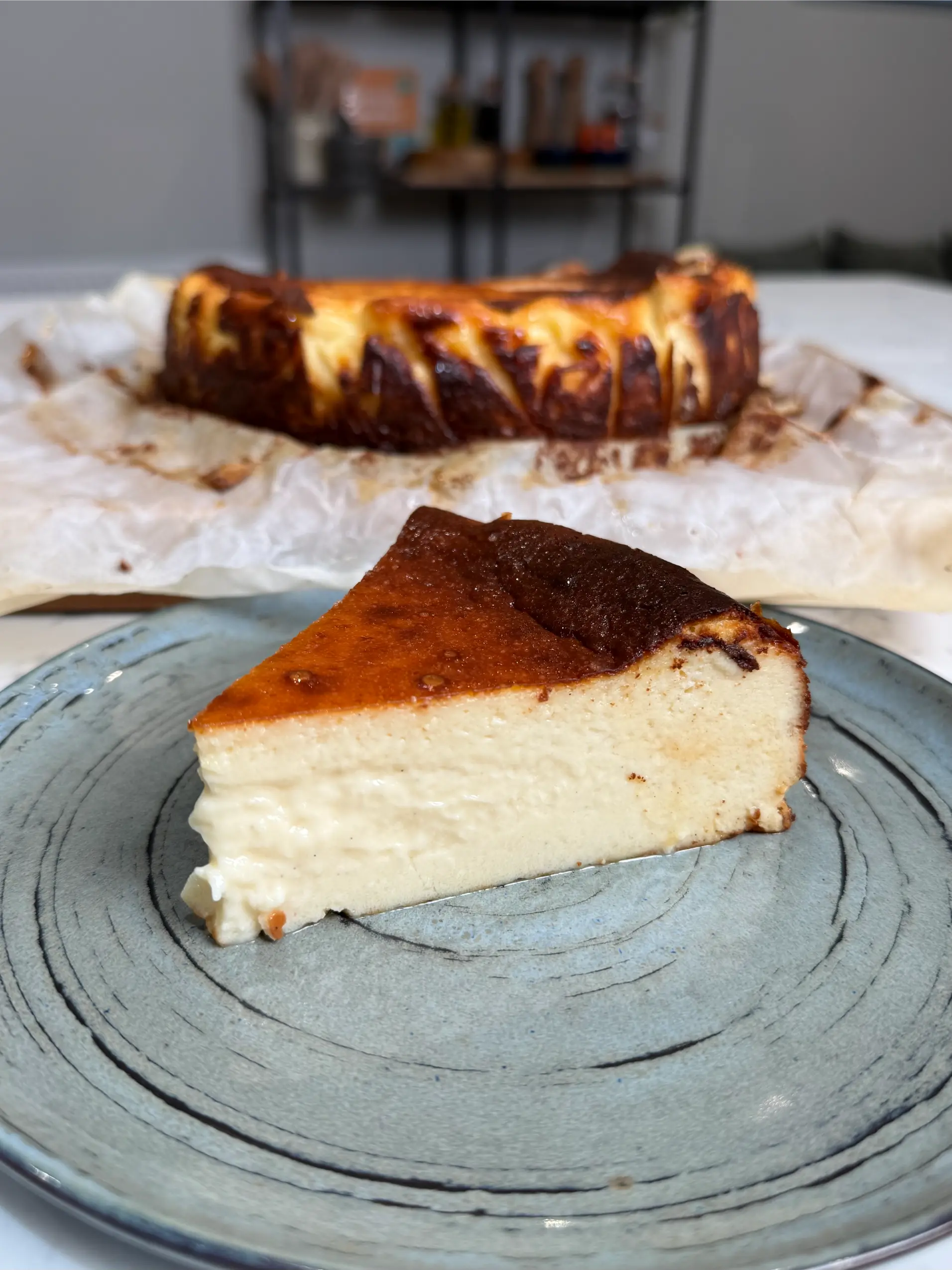
Basque Cheesecake
Ingredients
- 840 g Philadelphia cream cheese room temperature
- 380 g caster sugar
- 6 large eggs
- 1 tbsp plain flour
- 180 ml double cream
- 2 tsp vanilla bean paste
Instructions
- Preheat the oven to 210°C.
- Add the cream cheese, caster sugar, eggs, flour, double cream, and vanilla bean paste to a large bowl.
- Whisk until completely smooth and silky. You can use an electric mixer, or a hand whisk.
- Line a 22cm springform tin with parchment paper, making sure the paper comes higher than the edges of the tin. Don’t worry if it looks messy, that’s exactly how it should look. Pour the cheesecake mixture into the lined tin.
- Bake on the middle shelf for 35-40 minutes. The top should be deeply golden and almost burnt looking, while the middle still has a proper wobble to it.
- Leave it to cool at room temperature for around an hour, then transfer to the fridge until fully chilled. Overnight is even better. Slice up and serve cold.


5 comments on “Basque Cheesecake”
Hi Jon, do you use a fan oven at that temperature? Thanks
yes, fan oven!
Tasty
Jon, this is too big for us, we are only 2, halving the recipe will not make a difference will it?
you can halve the recipe but you will need to use a 15/16cm tin instead