

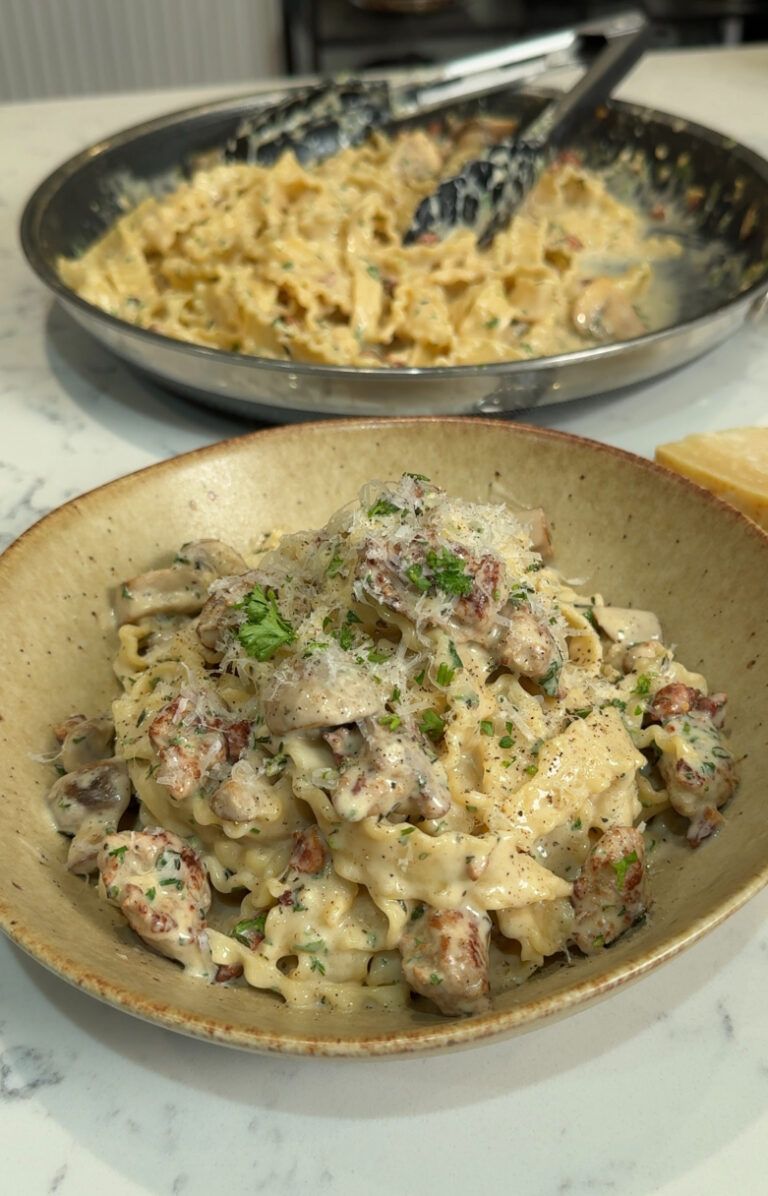
Sausage, Bacon & Mushroom Pasta
Sausage, bacon and mushrooms are three ingredients that work incredibly well together, particularly when there’s pasta and a creamy sauce involved. This recipe combines golden pieces of sausage meat, smoky bacon lardons and chestnut mushrooms with a silky mascarpone and Parmesan sauce, finished with fresh herbs and a little Dijon mustard.
It’s rich and comforting, but there’s more to the sauce than just cheese. The dry white wine brings a little acidity, the Dijon mustard cuts through the richness, and the fresh thyme works particularly well with the pork and mushrooms.
One of the things I like about using sausages in pasta dishes is that they’re already seasoned. Rather than buying plain pork mince and adding lots of different ingredients to give it flavour, you can simply remove the sausage meat from the skins and fry it until golden. It’s a great shortcut.
The sauce comes together in the same frying pan, making the most of all the flavour left behind by the sausage, bacon and mushrooms. There’s no need to make a separate cheese sauce or use flour to thicken anything. A little mascarpone, Parmesan and reserved pasta water are all you need to create a lovely silky consistency.
If you’re looking for an easy creamy sausage pasta, something different to make with a couple of leftover sausages, or simply a quick dinner that feels a little indulgent, this is well worth trying.
A creamy pasta sauce without double cream
Mascarpone is an ingredient I’d encourage more people to use in their cooking. Most people associate it with tiramisu and desserts, but it’s equally good in savoury dishes.
It’s a soft Italian cheese with a high fat content, a mild flavour and an incredibly smooth texture. When stirred into a hot frying pan with a little pasta water, it melts into a beautifully creamy sauce.
For this recipe, I’m only using 90g of mascarpone. That might not sound like much for 200g of pasta, but once it’s combined with the reduced white wine, Parmesan and starchy pasta water, there’s plenty of sauce to coat everything.
The mascarpone also has quite a neutral flavour, which allows the smoky bacon, sausage meat, mushrooms and fresh herbs to come through.
Unlike a traditional cream sauce, there’s very little need to reduce it once the cheese has been added. It’s already thick enough, so you’re actually looking to loosen it rather than thicken it.
Choosing the best sausages for pasta
I’d recommend using good-quality pork sausages with a reasonably high meat content. You only need two for this recipe, so it’s worth choosing ones with plenty of flavour.
Traditional British pork sausages work brilliantly, but Cumberland sausages, Lincolnshire sausages or Italian-style fennel sausages would all bring something slightly different to the dish.
Cumberland sausages tend to have a more peppery flavour, while Lincolnshire sausages are often seasoned with sage. Italian-style sausages containing fennel would give the pasta a more Mediterranean flavour.
Removing the sausage meat from the skins allows you to break it into smaller pieces as it cooks. This means you get little nuggets of golden sausage meat throughout the pasta rather than large slices.
Try not to break the meat up too finely. You want some texture, with little pieces that become beautifully caramelised on the outside.
The importance of getting some colour in the pan
The biggest difference between an average sausage pasta and a really good one often comes down to how you cook the meat and mushrooms.
When the sausage meat goes into the frying pan, resist the temptation to stir it constantly. Give it a chance to sit against the hot surface and develop some colour.
That browning is caused by the Maillard reaction, a chemical reaction between proteins and sugars that creates hundreds of different flavour compounds.
It’s responsible for much of the flavour we associate with a good steak, crispy bacon or freshly baked bread.
Once the sausage meat starts turning golden, add the smoked bacon lardons. The bacon will release some of its fat as it cooks, which brings even more flavour to the pan.
By the time you add the mushrooms, you’ve already created a fantastic base for the sauce without adding any stock or complicated seasoning.
Why chestnut mushrooms are a great choice
Chestnut mushrooms have a slightly deeper, earthier flavour than ordinary white button mushrooms. They’re also reasonably firm, which makes them particularly good for frying.
I’ve quartered the mushrooms in this recipe rather than slicing them thinly.
There are a couple of reasons for that. Firstly, mushrooms shrink considerably as they cook, so starting with larger pieces gives you a better texture in the finished pasta.
Secondly, I like having noticeable pieces of mushroom alongside the sausage meat and bacon.
Mushrooms contain a lot of water, so they need a little time in the frying pan to release that moisture before they begin to brown properly.
If the pan is overcrowded or the heat is too low, they’ll effectively steam rather than fry. Give them enough space and time to develop some colour before adding the garlic and thyme.
You could also use portobello, shiitake or a mixture of wild mushrooms if you wanted to make the dish a little more special.
What does white wine add to pasta sauce?
The 100ml of dry white wine in this recipe does several jobs.
Firstly, it deglazes the frying pan. When you pour the wine into the hot pan, it helps release all those caramelised bits of sausage, bacon and mushroom stuck to the bottom.
Those little browned bits contain loads of flavour, and you want them incorporated into the sauce rather than left behind.
Secondly, the acidity of the wine balances the richness of the mascarpone and pork.
Without something to cut through that richness, creamy pasta dishes can sometimes feel a little heavy.
Allow the wine to reduce by approximately half before adding the mascarpone. This concentrates its flavour and prevents the finished sauce from becoming too watery.
As for which wine to use, a dry Sauvignon Blanc or Pinot Grigio would be ideal. You certainly don’t need anything expensive, but I’d avoid particularly sweet white wines.
The little ingredients that make a big difference
There are three ingredients in this recipe that might seem relatively insignificant but really help bring everything together.
Dijon mustard: Just one teaspoon adds a gentle tang and helps balance the richness of the cheese and bacon. The finished pasta shouldn’t taste strongly of mustard.
Fresh thyme: Thyme has a lovely earthy, aromatic flavour that works particularly well with mushrooms and pork. Cooking it briefly with the garlic allows those flavours to develop before the wine goes in.
Fresh parsley: Adding parsley at the end brings freshness to an otherwise quite rich dish. Flat-leaf parsley would be my preference.
It’s these little additions that stop the pasta from simply tasting like meat and cheese.
Choosing the right pasta shape
There isn’t a particular pasta shape you have to use for this recipe, which makes it a great opportunity to use whatever you’ve already got in the cupboard.
Tagliatelle and pappardelle are excellent choices because their wide ribbons carry creamy sauces beautifully.
Rigatoni is another favourite of mine. The hollow tubes and ridged surfaces catch little pieces of sausage meat, bacon and sauce.
Mafaldine, with its distinctive ruffled edges, would also work particularly well.
If you’ve only got penne, fusilli or spaghetti, don’t let that put you off making it. The sauce will work with pretty much any dried pasta.
The important thing is to cook it until al dente, as it’ll spend a little more time in the frying pan while you toss everything together.
Pasta water is the secret to a silky sauce
If there’s one habit worth getting into when cooking pasta, it’s reserving some of the cooking water before draining it.
As pasta cooks, it releases starch into the surrounding water. That starchy liquid helps the fat from the mascarpone, bacon and sausage combine with the other liquids in the pan.
The result is a smoother sauce that clings to the pasta rather than pooling underneath it.
Start with a small splash when adding the mascarpone, then add more once the cooked pasta and Parmesan go into the pan.
There’s no exact amount you need to use because different pasta shapes release different amounts of starch, and the sauce may reduce slightly differently each time.
You’re looking for a glossy sauce that coats every piece of pasta without being thick or claggy.
Remember that creamy pasta sauces tend to thicken slightly as they cool, so leave the sauce a little looser than you think it needs to be.
Ingredient substitutions and variations
This is a particularly adaptable pasta recipe, and there are plenty of ways to make it using ingredients you already have.
Ingredient | Suggested alternative |
|---|---|
Pork sausages | Italian sausage, Cumberland sausage or chicken sausages |
Smoked bacon lardons | Pancetta or chopped streaky bacon |
Chestnut mushrooms | Button mushrooms, portobello or cremini mushrooms |
Mascarpone | Full-fat cream cheese or double cream |
Parmesan | Grana Padano or Pecorino Romano |
White wine | Chicken stock with a little lemon juice |
Dijon mustard | Wholegrain mustard |
Fresh thyme | Dried thyme |
Fresh parsley | Fresh chives |
You could also add a handful of baby spinach towards the end of cooking, some frozen peas for a little sweetness or chilli flakes if you fancy a bit of heat.
For an even smokier version, try replacing the bacon with smoked pancetta.
If you’re using double cream instead of mascarpone, bear in mind that you’ll need to simmer the sauce for a little longer to achieve a similar consistency.
Common mistakes to avoid
Adding the mushrooms too early
Get some colour on the sausage meat and bacon first. The moisture released by the mushrooms can otherwise prevent the meat from browning properly.
Not reducing the white wine
Adding mascarpone before the wine has reduced sufficiently can leave the sauce too thin and with an overpowering wine flavour.
Adding too much salt
Sausages, smoked bacon, Parmesan and salted pasta water all contribute seasoning. Taste the finished sauce before adding any extra salt.
Overheating the cheese sauce
Once the mascarpone and Parmesan have been added, keep the heat relatively gentle. Aggressive boiling can cause the sauce to separate or become oily.
Forgetting to reserve pasta water
Without it, it’s much harder to achieve that lovely silky consistency. Get into the habit of scooping out a mugful before draining your pasta.
What to serve with sausage, bacon and mushroom pasta
This pasta is quite rich, so I’d generally serve it with something fresh rather than another particularly heavy dish.
A rocket salad with lemon juice, olive oil and Parmesan shavings would be lovely. The peppery rocket and acidity of the lemon would balance the creamy sauce.
Tenderstem broccoli, roasted asparagus or steamed green beans would also work well.
Of course, if you’re going all in on the comfort food, a few slices of homemade garlic bread are never a bad idea.
Storing and reheating leftovers
Creamy pasta dishes are generally at their best when freshly cooked, but there’s no reason to waste any leftovers.
Allow the pasta to cool promptly before transferring it to an airtight container and refrigerating. Eat within two days.
When reheating, add a small splash of water or milk to loosen the sauce. The pasta will absorb some of the moisture while sitting in the fridge, so it’ll probably be considerably thicker the following day.
Reheat gently in a frying pan or microwave until piping hot throughout, stirring occasionally.
I wouldn’t particularly recommend freezing the finished dish. Mascarpone-based sauces can separate after freezing and defrosting, while the pasta and mushrooms may lose some of their texture.
Equipment needed
Large frying pan
Saucepan for cooking the pasta
Sharp knife
Chopping board
Spatula or wooden spoon
Colander
Measuring jug
Kitchen scales
Fine cheese grater
Kitchen tongs
A large, wide frying pan is particularly useful for this recipe. It gives the mushrooms and meat enough room to brown properly and makes tossing the pasta through the sauce much easier.
Making this recipe in the US
This creamy sausage, bacon and mushroom pasta is straightforward to make in America. There are just a few differences in ingredient names and measurements worth knowing.
UK ingredient | US equivalent |
|---|---|
200g pasta | 7 oz dried pasta |
2 pork sausages | 2 fresh pork sausage links, casings removed |
100g smoked bacon lardons | 3½ oz thick-cut smoked bacon, diced |
150g chestnut mushrooms | 5⅓ oz cremini or baby bella mushrooms |
90g mascarpone | 3.2 oz mascarpone cheese |
30g Parmesan | Approximately 1 oz Parmesan |
100ml dry white wine | Scant ½ US cup dry white wine |
5g fresh thyme | Approximately 0.18 oz fresh thyme |
10g fresh parsley | Approximately ⅓ oz fresh parsley |
British chestnut mushrooms are generally sold as cremini or baby bella mushrooms in American grocery stores.
Bacon lardons are small, thick pieces of bacon. If you can’t find them already prepared, simply dice some thick-cut smoked bacon.
British-style pork sausages may be labelled as bangers in America. Mild Italian sausage is also an excellent alternative, although the seasoning will be slightly different.
Mascarpone is usually available in the speciality cheese section of American grocery stores.
Frequently asked questions
Can I make sausage and mushroom pasta without white wine?
Yes. Replace the white wine with 100ml of chicken stock and add a small squeeze of lemon juice for acidity. Allow the stock to reduce slightly before adding the mascarpone.
Does all the alcohol cook out of the white wine?
Not necessarily. Although reducing the wine removes some alcohol, a short cooking time won’t guarantee that it’s completely alcohol-free. Use chicken stock instead if you need to avoid alcohol entirely.
Can I use cream cheese instead of mascarpone?
Yes. Full-fat cream cheese is a good alternative, although it has a slightly tangier flavour. You may need a little extra pasta water to loosen the sauce.
Can I use double cream instead of mascarpone?
Absolutely. Double cream, or heavy cream in America, works well. Start with around 100ml and simmer gently until the sauce reaches your preferred consistency.
What sausages are best for creamy sausage pasta?
Good-quality pork sausages are ideal. Cumberland, Lincolnshire and mild Italian sausages all work particularly well with mushrooms and creamy sauces.
Can I use sausage meat instead of whole sausages?
Yes. Buying sausage meat separately saves you the job of removing the skins. Use approximately the same weight of sausage meat as the two sausages you’d otherwise use.
Can I use pancetta instead of bacon?
Yes. Pancetta is an excellent alternative to bacon lardons and brings a lovely savoury pork flavour to the sauce.
Why is my mascarpone pasta sauce oily?
The sauce may have become too hot, causing the fat to separate. Reduce the heat and gradually toss through a little warm pasta water to help bring it back together.
Why is my creamy pasta sauce too thick?
Mascarpone and Parmesan naturally create a thick sauce, particularly as they cool. Add a splash of reserved pasta water and toss everything together until silky.
Can I make this pasta without mushrooms?
Yes. Simply leave them out or replace them with courgettes, spinach or sliced leeks. The sausage and bacon will still provide plenty of flavour.
Can I use dried thyme instead of fresh thyme?
Yes. Dried thyme is more concentrated than fresh, so start with around half a teaspoon and adjust to taste.
Can I add chicken to sausage and bacon pasta?
You can. Diced chicken breast or thigh would work well, particularly if you want to make the dish more substantial. Make sure the chicken is fully cooked before serving.
Can I make sausage and mushroom pasta gluten-free?
Yes. Use gluten-free pasta and check that your sausages, mustard and other packaged ingredients are suitable for a gluten-free diet.
Can I make this recipe vegetarian?
Yes, with a few substitutions. Use vegetarian sausages, omit the bacon or replace it with a plant-based alternative, and use a vegetarian Italian-style hard cheese instead of traditional Parmesan.
Can I make the mascarpone sauce ahead of time?
You can prepare the cooked sausage, bacon and mushroom mixture ahead of time, refrigerate it and reheat it thoroughly before finishing the sauce. I’d recommend adding the mascarpone and freshly cooked pasta just before serving for the best texture.
What is the difference between mascarpone and cream cheese?
Mascarpone generally has a higher fat content, a milder flavour and a softer, silkier texture. Cream cheese tends to be slightly firmer and tangier. Both can be used in pasta sauces.
Can I use fresh pasta instead of dried pasta?
Definitely. Fresh tagliatelle or pappardelle would be particularly good. Fresh pasta cooks much more quickly, so time it carefully to coincide with the sauce being ready.
How can I make this pasta a little lighter?
You could reduce the amount of bacon, use leaner sausages and replace some of the mascarpone with a reduced-fat cream cheese. Adding extra mushrooms or spinach is another good way to increase the vegetable content.
Final thoughts
What makes this Sausage, Bacon & Mushroom Pasta particularly good is how much flavour you can develop from such a short list of ingredients.
The sausage and bacon do much of the hard work, the mushrooms bring an earthy savouriness, and the white wine lifts all that caramelised flavour from the frying pan. The mascarpone simply brings everything together.
If you’re making this recipe, spend a little extra time getting some colour on the meat and mushrooms, and don’t forget to reserve that pasta water.
Those two things will make far more difference to the finished dish than adding another handful of ingredients.
Finish with plenty of freshly grated Parmesan, and you’ve got a dinner that feels considerably more indulgent than the effort involved in making it.
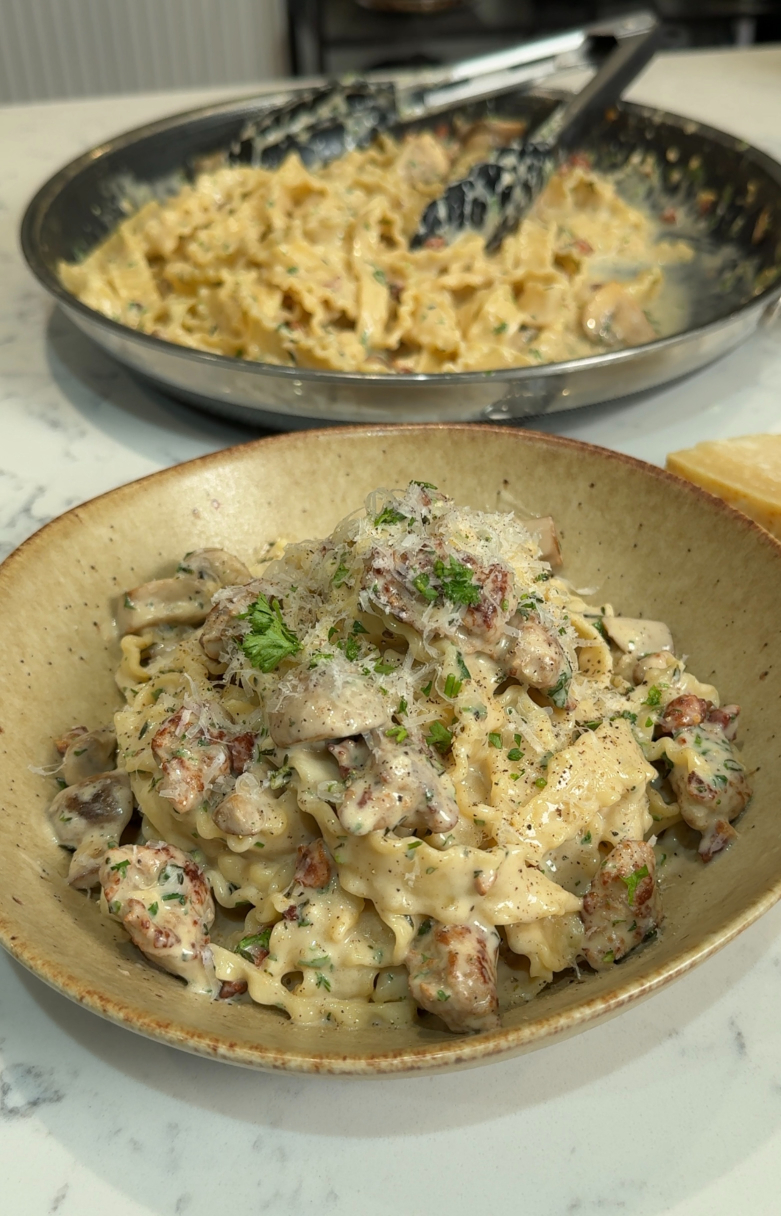
Sausage, Bacon & Mushroom Pasta
Ingredients
- 200 g pasta
- 2 pork sausages
- 100 g smoked bacon lardons
- 150 g chestnut mushrooms cut into quarters
- 2 garlic cloves finely chopped
- 90 g mascarpone
- 30 g Parmesan grated
- 100 ml dry white wine
- 1 tsp Dijon mustard
- 5 g fresh thyme chopped
- 10 g parsley chopped
Instructions
- Remove the sausage meat from the skins. Heat some cooking oil in a large frying pan then add the sausage meat and break it up with a spatula. Cook until it starts to turn golden brown.
- Add the bacon and fry until almost crispy, meanwhile, cook the pasta in salted boiling water.
- Add the mushrooms to the sausage and bacon and cook until golden and softened. Stir in the garlic and thyme and cook for a further minute.
- Pour in the white wine and let it reduce by half, then stir in the mascarpone and Dijon mustard into the pan with a splash of pasta water.
- Add the cooked pasta, Parmesan and parsley. Toss everything together, adding more pasta water until silky.
- Finish with more grated Parmesan, and enjoy.