

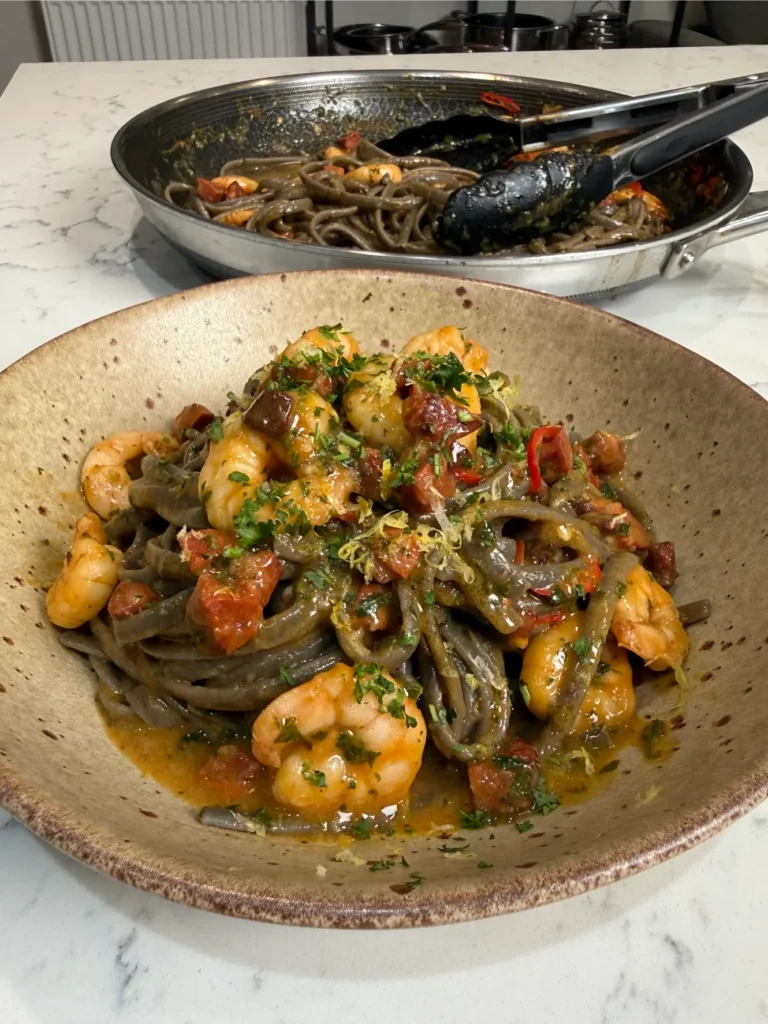
Chorizo & Prawn Linguine
This Chorizo & Prawn Linguine came about after I picked up some squid ink linguine while I was in Kefalonia recently and wanted an excuse to use it.
Squid ink pasta has that dramatic black colour and a subtle savoury, slightly briny flavour, so prawns felt like an obvious place to start. Then I added crispy chorizo, because the smoky paprika oils it releases are incredible with seafood.
The result is a really simple pasta that’s absolutely packed with flavour.
You’ve got crispy pieces of chorizo, juicy king prawns, garlic and fresh chilli, all tossed through linguine in a glossy sauce made with white wine, butter, lemon and pasta water.
It looks impressive – particularly if you use the squid ink linguine – but there’s really not much to it. The sauce comes together in the time it takes the pasta to cook, so you can have the whole thing on the table in around 20 minutes.
And don’t worry if you can’t find squid ink linguine. Normal linguine or spaghetti works perfectly.
Chorizo and prawns are such a good combination
Prawns have a delicate sweetness, while chorizo brings saltiness, smokiness and spice.
Put the two together and they balance each other brilliantly.
The other reason chorizo works so well here is the oil.
As the diced chorizo cooks, the fat renders out and turns a beautiful deep orange-red from the paprika. Instead of adding loads of olive oil to the pan, that chorizo oil becomes the flavour base for everything else.
The prawns, garlic and chilli all cook in it, so that smoky chorizo flavour ends up running through the entire dish.
What is squid ink linguine?
Squid ink pasta is pasta that’s had squid or cuttlefish ink incorporated into the dough, giving it that distinctive black colour.
You’ll often see it paired with seafood, particularly prawns, crab, squid and shellfish.
The flavour isn’t overwhelmingly fishy. It’s actually fairly subtle, with a slight savoury, salty character.
For me, one of the biggest appeals is how good it looks.
The black pasta against the red chorizo, pink prawns, chilli and green parsley makes this look like a much more elaborate plate of food than it actually is.
I picked mine up while I was in Kefalonia, which is what inspired the recipe in the first place.
But I wouldn’t go hunting around five different shops just to find it.
Normal linguine is absolutely fine.
Can I use normal linguine?
Definitely.
Squid ink linguine makes this dish visually striking, but it isn’t essential to the recipe.
Regular linguine gives you exactly the same silky texture and works brilliantly with the sauce.
Spaghetti would be my next choice.
You could also use tagliatelle or another long pasta you’ve already got in the cupboard.
The important thing is the combination of chorizo, prawns and that buttery white wine sauce rather than the colour of your pasta.
Start by crisping the chorizo
There’s no need to add oil to the pan before cooking the chorizo.
Add it directly to a frying pan over a medium-high heat and give it two or three minutes.
You’ll see the pieces start to colour and crisp around the edges while all that beautifully flavoured oil begins to render out.
That’s your cooking fat.
And don’t drain it away.
It contains a ridiculous amount of flavour that we want to carry through the rest of the sauce.
Don’t overcook the prawns
King prawns cook incredibly quickly.
I’ve used raw king prawns here and they only need a couple of minutes in the pan before you move on to the garlic and chilli.
They’re going to remain in the pan while the wine reduces and everything gets tossed together, so you don’t want to completely hammer them at the beginning.
Overcooked prawns quickly become rubbery.
As soon as they turn from translucent to pink and opaque, they’re pretty much there.
If your prawns are particularly large, they may need slightly longer.
Garlic and fresh chilli
There are three cloves of garlic and a whole red chilli in this recipe.
They only need around 30 seconds in the hot pan.
By this stage, the chorizo has released its oil and everything is pretty hot, so minced garlic can burn extremely quickly.
You’re looking for that moment when you can really smell the garlic and chilli.
Then get the wine in.
If you don’t want too much heat, remove the seeds from the chilli before slicing it. If you like things hotter, leave them in or add another chilli.
Why add white wine to pasta sauce?
White wine does a few things here.
Firstly, it deglazes the pan.
All those little caramelised bits of chorizo, prawn and garlic stuck to the bottom are full of flavour. When the wine hits the hot pan, you can scrape those back into the sauce.
Secondly, the acidity of the wine balances the richness of the chorizo and butter.
And finally, once it’s reduced, you’re left with a more concentrated flavour rather than a pasta sauce that simply tastes of wine.
Let the wine bubble for a minute or two until it’s reduced by roughly half before adding the pasta.
What white wine should I use?
You want a dry white wine rather than anything particularly sweet.
Sauvignon Blanc, Pinot Grigio or an unoaked Chardonnay would all work.
You don’t need an expensive bottle.
At the same time, don’t cook with something you absolutely hate drinking. As the wine reduces, its flavours become more concentrated.
A decent everyday dry white is perfect.
And then you’ve conveniently got most of a bottle left to drink with dinner.
The secret to the glossy sauce
There’s no cream in this pasta.
The sauce comes from the combination of chorizo oil, reduced white wine, butter, lemon and starchy pasta water.
Once the cooked linguine goes into the pan, add the butter, lemon juice, parsley and a generous splash of reserved pasta water.
Then toss.
As you toss everything together over the heat, the butter and chorizo fat emulsify with the water, creating a glossy sauce that coats the strands of linguine.
This is why pasta water is so useful.
Without it, you’ve essentially got oily pasta.
With it, you can bring those fats and liquids together into a proper sauce.
Always save your pasta water
If you’ve read a few of my pasta recipes, you’ll have heard me say this plenty of times.
Before you drain your pasta, save a mug of the cooking water.
Get into the habit of doing it every single time.
As the pasta cooks, starch is released into the water. That starch helps sauces emulsify and cling to the pasta.
Here, it’s particularly important because there isn’t a traditional tomato or cream sauce.
Start with a good splash and add more if the pasta looks dry.
You want the finished linguine glossy and loose rather than swimming in liquid.
Lemon makes a huge difference
You’ve got some fairly rich ingredients here.
Chorizo.
Butter.
The rendered fat from the chorizo.
Without anything acidic, the finished dish could feel quite heavy.
That’s where the lemon comes in.
The juice of half a lemon gets tossed through the pasta, then I finish each bowl with fresh lemon zest.
That acidity cuts through the richness and works particularly well with the prawns.
Taste it before serving. If you think it needs a little more freshness, squeeze over some more lemon.
Should you add Parmesan to prawn pasta?
You’ll notice there’s no Parmesan in this recipe.
There’s a traditional Italian convention of not pairing cheese with seafood, although like most food “rules”, there are exceptions.
More importantly, I just don’t think this pasta needs it.
There’s already loads of richness and saltiness coming from the chorizo and butter, and Parmesan would start competing with the prawns.
The fresh parsley and lemon zest are a much better finish for this particular dish.
A brilliant dinner when you’re trying to impress
This is one of those recipes that looks like you’ve put far more effort into it than you actually have.
Use black squid ink linguine and it’s instantly quite dramatic.
But everything happens in basically the time it takes to boil the pasta.
That makes it brilliant for a date-night dinner or when you’ve got someone coming over and don’t want to spend the entire evening standing at the hob.
Get everything chopped before you start and the actual cooking is really quick.
What to serve with Chorizo & Prawn Linguine
You really don’t need much.
I’d happily serve a big bowl of this on its own.
If you want something alongside, some crusty bread is great for mopping up the buttery sauce.
A simple rocket salad with lemon and olive oil would work too.
And if you’ve opened a bottle of dry white wine to make the sauce, you’ve already sorted the drink.
Making this recipe in the US
This Chorizo & Prawn Linguine is easy to make in America, but there are a few useful ingredient translations.
200g linguine is approximately 7 oz pasta.
120g chorizo is approximately 4¼ oz chorizo. Look for Spanish-style cured chorizo, rather than fresh Mexican chorizo. You want something firm that can be diced and crisped in the pan.
200g raw king prawns is approximately 7 oz raw large or jumbo shrimp. What we generally call prawns in the UK are normally labelled shrimp in US supermarkets.
150ml dry white wine is approximately ⅔ cup.
25g butter is approximately 2 tablespoons butter.
10g parsley is roughly ¼ cup chopped fresh parsley.
The rest of the ingredients translate directly.
If you can’t find squid ink linguine, don’t worry. Regular linguine or spaghetti works perfectly.
So if you’ve found this recipe while searching for shrimp and chorizo pasta, it’s the same dish – we’re just calling them prawns over here.
Ingredients
200g squid ink linguine, although ordinary linguine is absolutely fine
120g chorizo, diced
200g raw king prawns
3 cloves garlic, minced
1 red chilli, sliced
150ml dry white wine
25g butter
1 lemon
10g parsley, chopped
Method
- Cook the linguine in a large pan of salted boiling water according to the packet instructions. Before draining, scoop out a mugful of the pasta water.
- Meanwhile, add the chorizo to a large frying pan over a medium-high heat. Cook for 2 to 3 minutes until it starts to crisp and releases its oils.
- Add the prawns and cook for 1 to 2 minutes, then add the garlic and chilli and cook for another 30 seconds.
- Pour in the white wine and let it bubble for 1 to 2 minutes, until reduced by around half.
- Add the drained linguine to the pan along with the butter, juice of half the lemon, parsley and a good splash of reserved pasta water.
- Toss everything together over the heat until the butter has melted and the pasta is coated in a glossy sauce. Add another splash of pasta water if it needs loosening.
- Taste for seasoning, dish it up and finish with some freshly grated lemon zest.
Equipment
Large saucepan
Large frying pan
Colander or pasta tongs
Sharp knife
Chopping board
Wooden spoon or silicone tongs
Fine grater or zester
FAQs
Can I use normal linguine instead of squid ink linguine?
Absolutely. Squid ink linguine looks fantastic and has a subtle savoury flavour, but ordinary linguine or spaghetti works perfectly.
What does squid ink pasta taste like?
Squid ink pasta has a subtle savoury, slightly briny flavour. It isn’t overwhelmingly fishy, so even if you’ve never tried it before, don’t be put off by the dramatic black colour.
Can I use cooked prawns instead of raw prawns?
You can, but add them much later. Cooked prawns only need heating through, so adding them at the same stage as raw prawns risks making them tough and rubbery.
What are king prawns called in America?
They’re generally sold as large or jumbo shrimp in the US.
Which chorizo should I use?
Use a firm, Spanish-style cured chorizo that you can dice. It releases loads of beautifully flavoured paprika oil as it fries.
Can I make this pasta without alcohol?
Yes. Replace the white wine with chicken or fish stock and add a little extra lemon juice for acidity. It won’t taste exactly the same, but you’ll still get a lovely sauce.
Does the alcohol cook out of the white wine?
Some of the alcohol evaporates as the wine bubbles and reduces, but a short cooking time doesn’t guarantee that every trace of alcohol disappears. If you need the dish to be alcohol-free, use stock instead.
Is Chorizo & Prawn Linguine spicy?
It has some warmth from both the chorizo and fresh chilli, but it shouldn’t be overwhelmingly hot. Remove the chilli seeds or use half a chilli if you prefer things milder.
Can I make this ahead of time?
This is definitely one I’d make fresh. Prawns are at their best when just cooked and the glossy butter sauce is much better straight from the pan.
Can I use frozen prawns?
Yes. Defrost them completely first and pat them dry before cooking. Excess water can cool the pan and prevent the prawns from frying properly.
Why is my pasta sauce oily instead of creamy and glossy?
You probably need more pasta water and more tossing. The starchy water helps emulsify the chorizo fat and butter into the sauce. Add it a splash at a time while vigorously tossing the linguine over the heat.
Final thoughts
This is exactly my sort of pasta.
It looks impressive, particularly with the black squid ink linguine, but underneath all that it’s just a really simple 20-minute dinner.
Crisp the chorizo and use all that incredible paprika oil as the base. Don’t overcook the prawns. Reduce the wine properly, then use butter and plenty of starchy pasta water to bring everything together into a glossy sauce.
Finish it with lemon and parsley and you’ve got something rich, fresh, spicy and packed with flavour.
And while my packet of squid ink linguine might have travelled home from Kefalonia, yours absolutely doesn’t need to.
Normal linguine will do the job perfectly.
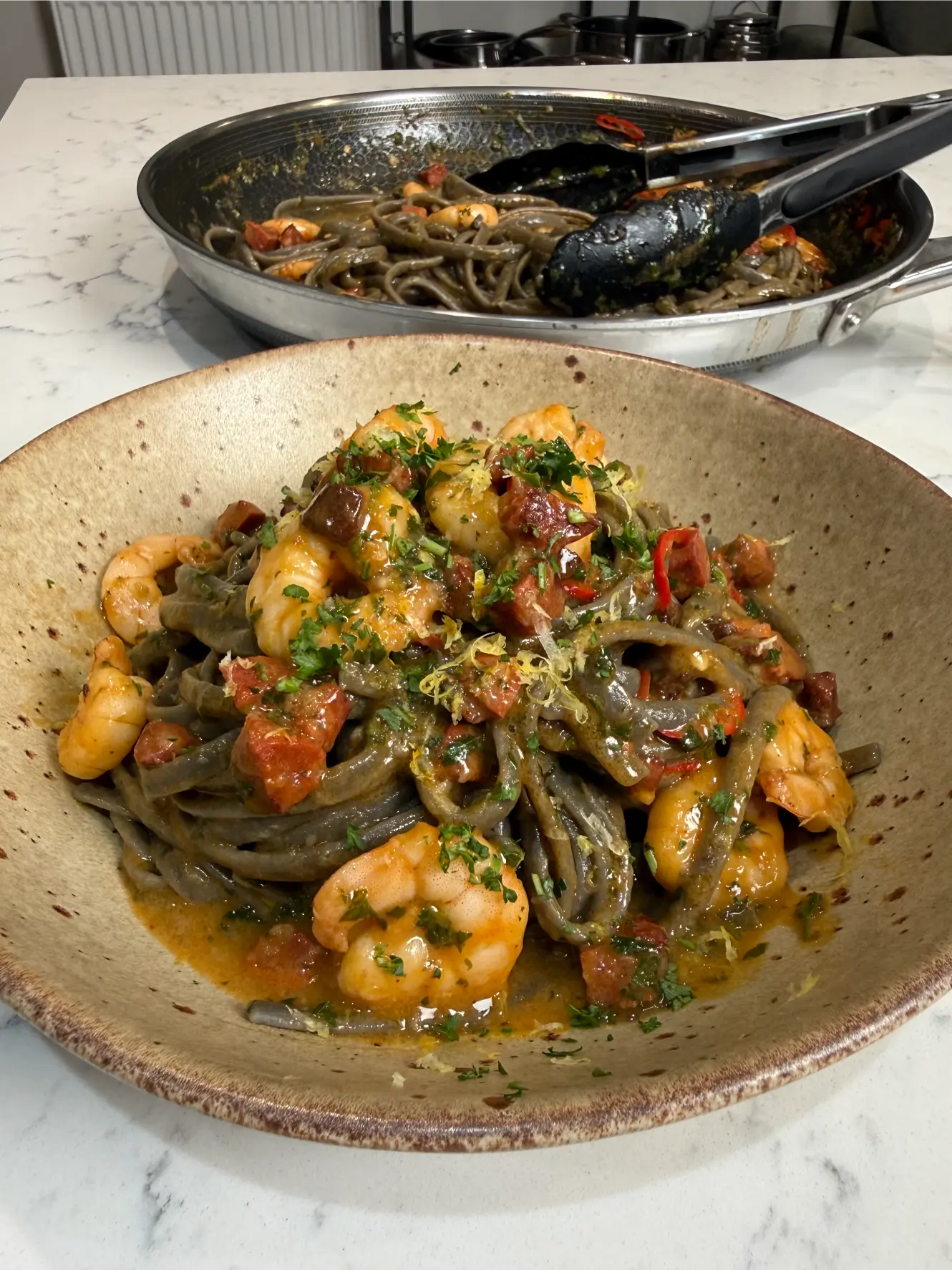
Chorizo & Prawn Linguine
Ingredients
- 200 g squid ink linguine ordinary linguine is fine
- 120 g chorizo diced
- 200 g raw king prawns
- 3 cloves of garlic minced
- 1 red chilli sliced
- 150 ml dry white wine
- 25 g butter
- 1 lemon
- 10 g parsley chopped
Instructions
- Cook the linguine in a large pan of salted boiling water according to the packet instructions. Before draining, scoop out a mugful of the pasta water.
- Meanwhile, add the chorizo to a large frying pan over a medium-high heat. Cook for 2-3 minutes until it starts to crisp up and releases its oils.
- Add the prawns and cook for 1-2 minutes, then add the garlic and chilli and cook for a further 30 seconds.
- Pour in the white wine and let it bubble away for 1-2 minutes, until reduced by about half.
- Add the drained linguine to the pan along with the butter, the juice of half of the lemon, parsley, and a good splash of the reserved pasta water.
- Toss everything together over the heat until the butter melts and the pasta is coated in a glossy sauce. Add another splash of pasta water if it needs loosening.
- Taste for seasoning, then dish it up and finish with some lemon zest.


1 comment on “Chorizo & Prawn Linguine”
Love this