

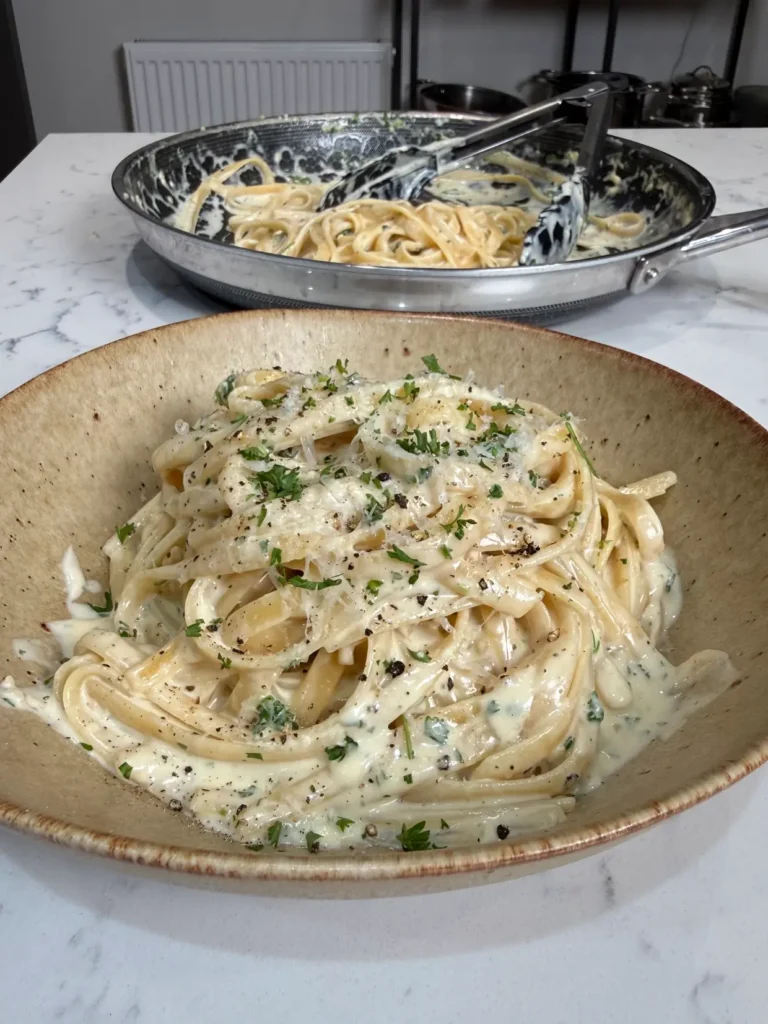
Fettuccine Alfredo
Few pasta dishes prove that simple ingredients can create something incredible quite like Fettuccine Alfredo.
Tender ribbons of fettuccine coated in a silky sauce made with butter, garlic, double cream and plenty of Parmesan. It’s rich, comforting and ridiculously easy to make, with the whole thing coming together in about the time it takes to cook the pasta.
Now, if you’re Italian, you might already be raising an eyebrow.
The original Italian version of fettuccine Alfredo is famously simple, traditionally made with butter, Parmesan and pasta water. But the creamy version has become a classic in its own right, particularly in America, where Alfredo sauce usually means that luxurious combination of butter, cream and Parmesan.
That’s the version I’m making here.
I’ve added a little garlic and fresh parsley too, because they bring freshness and extra flavour without taking away from what makes Alfredo so good in the first place.
This isn’t trying to be light or clever. It’s a proper bowl of creamy pasta, and sometimes that’s exactly what you need.
Fettuccine Alfredo
Creamy fettuccine tossed through a rich garlic and Parmesan sauce, finished with plenty of black pepper and extra cheese.
Simple, quick and proper comfort food.
What is Fettuccine Alfredo?
Fettuccine Alfredo has an interesting history because the dish people know around the world today isn’t quite the same as the original.
The dish is associated with Alfredo di Lelio, a restaurateur in Rome who served fettuccine tossed with butter and Parmesan in the early 20th century.
There was no double cream in the classic version.
The magic came from vigorously tossing hot pasta with butter, finely grated Parmesan and some of the starchy pasta water. As everything emulsified together, it created a beautifully creamy coating without actually using cream.
The dish eventually became particularly popular in the United States, where it evolved into the richer Alfredo sauce most people now recognise.
Heavy cream, butter, Parmesan and often garlic became standard ingredients.
So while an Italian might not recognise this as traditional Alfredo, the creamy American-style version has become a classic all of its own.
And that’s the inspiration for this recipe.
Why this version works
There are only a handful of ingredients here, which means every one of them matters.
Butter gives the sauce richness.
Garlic brings warmth.
Double cream creates that luxurious silky texture.
Parmesan adds saltiness and umami.
Pasta water brings everything together.
And fresh parsley cuts through the richness with a little freshness at the end.
There’s nowhere for bad ingredients or poor technique to hide, but thankfully there’s nothing particularly difficult about making it either.
The Parmesan matters
If you’re going to spend money on one ingredient here, make it the Parmesan.
Use proper Parmigiano Reggiano if you can and grate it yourself.
Pre-grated Parmesan often contains anti-caking agents that stop the cheese sticking together in the packet. Unfortunately, they can also prevent it melting as smoothly into sauces.
Freshly grated Parmesan melts much more easily and gives you a smoother, silkier Alfredo.
Grating it finely also helps.
The finer the cheese, the faster it’ll melt into the warm cream.
Don’t let the garlic brown
Garlic cooks incredibly quickly.
You’re only looking to gently soften it in the butter for around a minute.
If it starts turning dark brown, it can become bitter, and because this sauce contains so few ingredients, you’ll notice it immediately.
Keep the heat around medium and let the garlic gently infuse into the melted butter.
Your kitchen should smell amazing, but the garlic itself should stay fairly pale.
Why pasta water is so important
Before you drain your fettuccine, save a mug of the cooking water.
Always.
That cloudy water contains starch released by the pasta as it cooks, and it’s one of the most useful ingredients you can have when making pasta sauces.
Adding a splash to the Alfredo helps loosen the sauce while encouraging the fat, cream and cheese to emulsify.
The result is a sauce that looks glossy and clings to the pasta rather than sitting heavily in the bottom of the pan.
If your Alfredo looks too thick, don’t automatically reach for more cream.
Try pasta water first.
Keep the heat low when adding Parmesan
This is one of the most important parts of making a smooth Alfredo sauce.
Once the cream has gently reduced, turn the heat down before adding the Parmesan.
Cheese doesn’t particularly enjoy being aggressively boiled.
Too much heat can cause the proteins to tighten and separate, leaving you with a grainy or oily sauce instead of something smooth and glossy.
Add the finely grated Parmesan over a low heat and stir gently until melted.
Then add the pasta and let everything come together.
Why fettuccine is perfect for Alfredo sauce
There’s a reason fettuccine and Alfredo are almost inseparable.
Those wide, flat ribbons give the sauce plenty of surface area to cling to.
Every strand gets coated, meaning you get that creamy Parmesan flavour in every mouthful.
Tagliatelle is probably the closest substitute if you can’t find fettuccine.
Linguine works too, although it’s slightly narrower.
You could even use spaghetti if that’s what you’ve got in the cupboard. Nobody is coming round to confiscate your passport.
Cook the pasta al dente
You don’t want soft, overcooked fettuccine here.
Cook the pasta until al dente, meaning it’s cooked through but still has a slight bite.
Remember that the pasta spends another minute or two being tossed through the hot Alfredo sauce.
That final stage is part of the cooking process.
If you completely cook the pasta before adding it to the sauce, it can become too soft by the time you serve it.
Tossing is where the magic happens
Don’t simply pour the sauce over cooked pasta.
Get the fettuccine directly into the frying pan and toss everything together.
As the pasta moves through the sauce, starch from the pasta combines with the cream, butter and Parmesan.
Within a minute or two, you’ll notice the sauce becoming glossier and clinging more tightly to the fettuccine.
That’s exactly what you’re looking for.
What can I add to Fettuccine Alfredo?
This recipe is deliberately simple, but Alfredo makes a brilliant base for loads of variations.
Chicken is probably the most famous addition. Slice a seasoned chicken breast, pan fry it until golden and serve it over the pasta for classic Chicken Alfredo.
King prawns are brilliant too, especially fried quickly with garlic before making the sauce.
You could add mushrooms, crispy bacon, spinach or broccoli if you want to bulk it out.
But don’t feel like it needs anything.
Sometimes a massive bowl of Parmesan-coated pasta is enough.
What to serve with Fettuccine Alfredo
Because Alfredo is rich, I like keeping anything alongside it relatively simple.
A green salad with a sharp lemon dressing works brilliantly.
Tenderstem broccoli, asparagus or green beans also add some freshness.
And if you’re going all in on the comfort food, garlic bread alongside isn’t exactly going to make things worse.
Making this recipe in the US
This recipe is actually particularly well suited to American readers because the creamy version of Fettuccine Alfredo is hugely popular in the US.
There are just a couple of ingredient names and measurements to translate.
250g fettuccine is approximately 9 oz fettuccine.
20g butter is approximately 1½ tablespoons butter.
200ml double cream is approximately ¾ cup plus 1 tablespoon heavy cream. American heavy cream is the closest widely available substitute for British double cream. It contains slightly less fat, but works perfectly in this recipe.
80g Parmesan is approximately ¾ cup finely grated Parmesan, although weighing Parmesan will always give you the most consistent result.
10g parsley is approximately ¼ cup chopped fresh parsley.
The method stays exactly the same.
One useful terminology difference is that what we call double cream in the UK is generally called heavy cream or heavy whipping cream in the US.
So if you’ve landed here looking for an easy Fettuccine Alfredo recipe with heavy cream, you’re in exactly the right place.
Ingredients
250g fettuccine
20g butter
2 cloves garlic, minced
200ml double cream
80g Parmesan, finely grated, plus extra for serving
10g parsley, chopped
Method
- Cook the fettuccine in a large pan of salted boiling water until al dente. Before draining, reserve a mugful of the pasta water.
- Meanwhile, melt the butter in a large frying pan over a medium heat. Add the garlic and cook for 1 minute, making sure it doesn’t brown.
- Pour in the double cream, bring it to a gentle simmer and cook for 2 to 3 minutes until it starts to thicken slightly.
- Turn the heat down low, then add the Parmesan and parsley. Stir until the Parmesan melts into the cream and you have a smooth sauce.
- Add the cooked fettuccine straight into the sauce with a splash of the reserved pasta water. Toss everything together for a minute or two until the pasta is completely coated and the sauce is glossy and creamy.
- Season generously with black pepper and add salt if needed. If the sauce gets too thick, loosen it with another splash of pasta water.
- Divide between bowls, then finish with extra Parmesan and plenty of black pepper.
Equipment
Large saucepan
Large frying pan
Colander or pasta tongs
Fine cheese grater
Sharp knife
Chopping board
Wooden spoon or silicone spatula
FAQs
Is authentic Fettuccine Alfredo made with cream?
Traditional Roman-style fettuccine Alfredo is made with butter, Parmesan and pasta water rather than cream. The cream-based version became particularly popular in America and is now what many people recognise as Alfredo sauce.
What is double cream called in America?
Heavy cream or heavy whipping cream is the closest US equivalent and works perfectly in this recipe.
Why has my Alfredo sauce gone grainy?
The most common reason is excessive heat when adding the Parmesan. Turn the heat down low and use finely grated Parmesan, adding it gradually and stirring until melted.
Can I make Fettuccine Alfredo without double cream?
Yes. For a more traditional version, you can use butter, Parmesan and plenty of starchy pasta water to create an emulsified sauce. The flavour and texture will be slightly different from this creamy American-style recipe.
Can I use pre-grated Parmesan?
You can, but freshly grated Parmesan gives a much smoother sauce. Some pre-grated cheeses contain anti-caking agents that can prevent them melting properly.
How do I reheat Fettuccine Alfredo without the sauce splitting?
Reheat it gently over a low heat with a splash of milk, cream or water. Avoid blasting it over high heat because this can cause the cheese and fat to separate.
Can I make Chicken Fettuccine Alfredo with this recipe?
Absolutely. Pan fry seasoned chicken breast or thigh until cooked through, slice it and serve it over the finished Alfredo. You can also cook the chicken in the same frying pan before making the sauce for extra flavour.
What pasta can I use instead of fettuccine?
Tagliatelle is probably the best alternative because it has a similarly wide, flat shape. Linguine, spaghetti or even short pasta such as rigatoni will also work.
Why is my Alfredo sauce too thick?
Alfredo thickens quickly as it cools. Stir in reserved pasta water a little at a time until the sauce becomes silky and coats the fettuccine. Make it slightly looser than you think you need before serving.
Final thoughts
Fettuccine Alfredo is proof that you don’t need a long shopping list to make seriously good comfort food.
Butter, garlic, cream, Parmesan and pasta come together in minutes to create something rich, silky and incredibly satisfying.
The biggest difference comes from the little details. Cook the pasta al dente, save plenty of pasta water, grate the Parmesan fresh and keep the heat low when adding the cheese.
Do those things and you’ll end up with a glossy Alfredo sauce that clings to every ribbon of fettuccine.
It’s unapologetically creamy, incredibly simple and ready in the time it takes to cook the pasta.
Sometimes dinner really doesn’t need to be any more complicated than that.
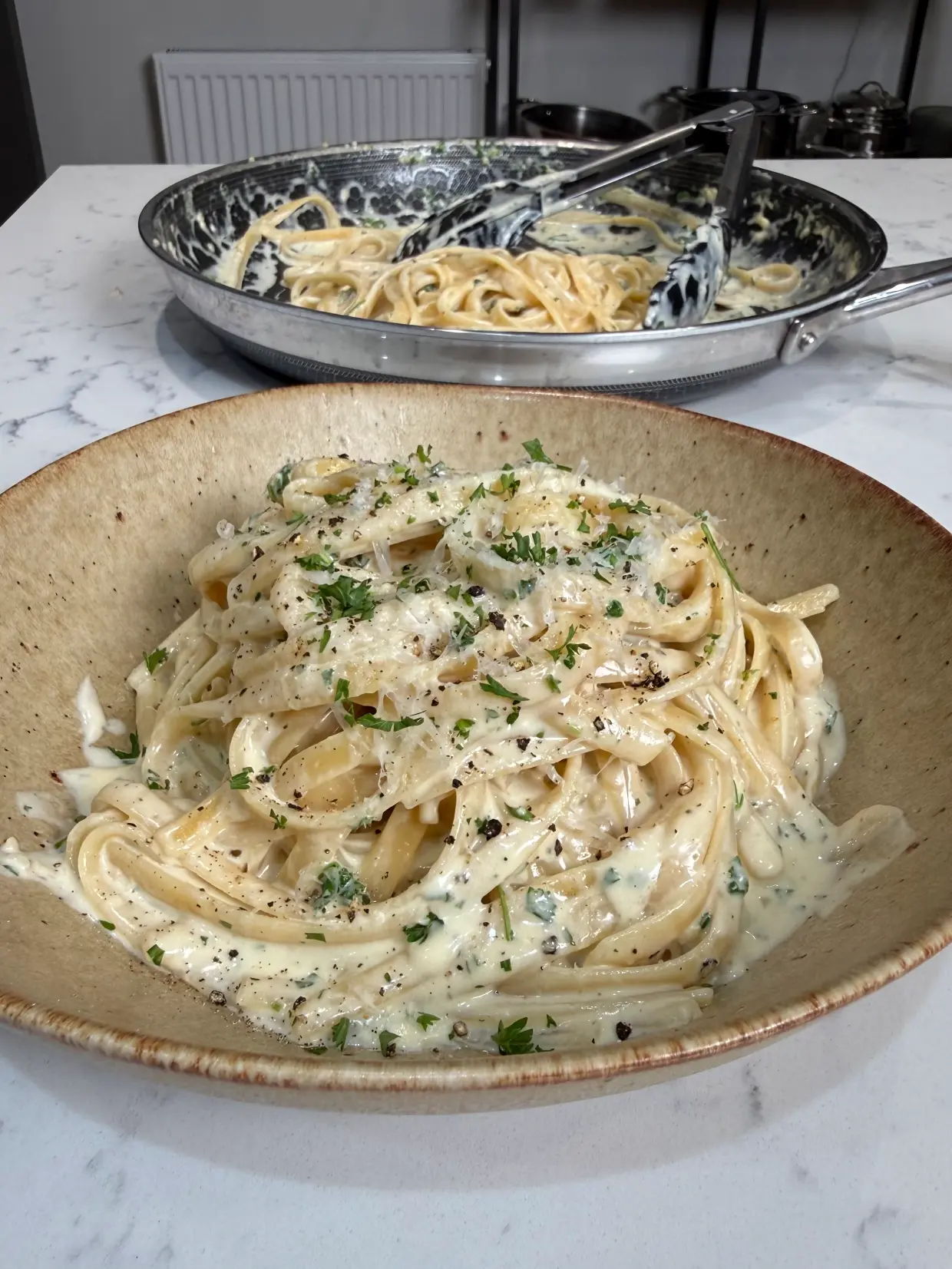
Fettuccine Alfredo
Ingredients
- 250 g fettuccine
- 20 g butter
- 2 cloves garlic minced
- 200 ml double cream
- 80 g Parmesan finely grated, plus extra for serving
- 10 g parsley chopped
Instructions
- Cook the fettuccine in a large pan of salted boiling water until al dente. Before draining, reserve a mugful of the pasta water.
- Meanwhile, melt the butter in a large frying pan over a medium heat. Add the garlic and cook for 1 minute, making sure it doesn’t brown.
- Pour in the double cream, bring it to a gentle simmer and cook for 2-3 minutes until it starts to thicken slightly.
- Turn the heat down low, then add the Parmesan, and parsley and stir until the parmesan melts into the cream and you have a smooth sauce.
- Add the cooked fettuccine straight into the sauce with a splash of the reserved pasta water. Toss everything together for a minute or two until the pasta is completely coated and the sauce is glossy and creamy.
- Season generously with black pepper and add salt if needed. If the sauce gets too thick, loosen it with another splash of pasta water.
- Divide between bowls, then finish with some extra Parmesan, and plenty of black pepper.


2 comments on “Fettuccine Alfredo”
How many does this serve
2 people