

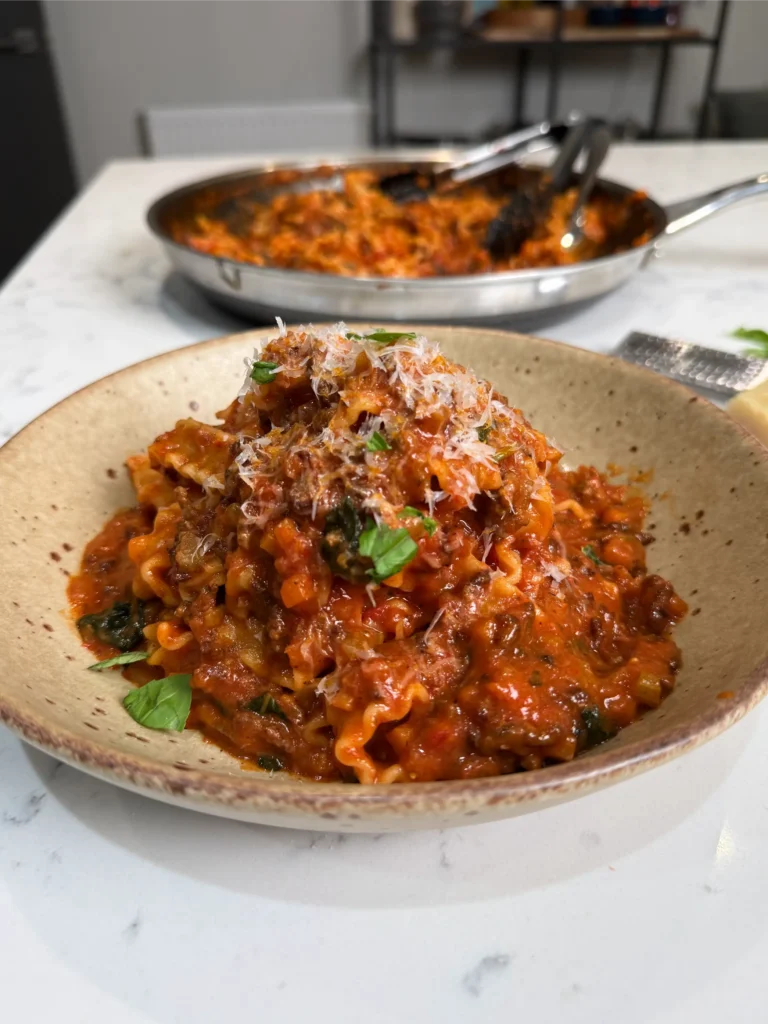
’Nduja Bolognese
Bolognese is one of those dinners I don’t think I’ll ever get bored of, but this version gives it a completely different edge.
It’s everything you want from a rich, comforting beef Bolognese, but with ’nduja melted into the sauce to add a smoky, spicy kick.
If you’ve never cooked with ’nduja before, it’s a soft, spreadable salami from Calabria in southern Italy. It’s made with pork and Calabrian chillies and, unlike a normal salami, it almost melts when you cook it. That makes it absolutely brilliant for pasta sauces because you get all that spicy, savoury flavour running through the entire dish rather than just getting occasional pieces of sausage.
For this recipe, I’ve kept the rest fairly classic. Beef mince is browned properly, onion, carrot and celery are slowly softened, then everything comes together with garlic, tomato paste, chopped tomatoes, beef stock, oregano and Parmesan.
It doesn’t need hours simmering away either.
The sauce cooks for around 15 minutes, then the pasta finishes cooking directly in it with a splash of pasta water, helping everything become rich and glossy.
It’s basically Bolognese with a bit more attitude.
What is ’nduja?
If you’ve seen ’nduja popping up on restaurant menus and supermarket shelves but have never actually bought it, you’re missing out.
’Nduja – generally pronounced something like en-doo-ya – originates from Calabria in southern Italy.
Unlike traditional cured sausages that you slice, ’nduja has a soft, spreadable consistency. It’s made predominantly from pork and chilli peppers, giving it a deep red colour and distinctive spicy flavour.
When heated, the pork fat melts and carries all that chilli and savoury flavour through whatever you’re cooking.
That’s why it works so well in pasta sauces.
You don’t need loads either.
There’s just 40g in this Bolognese, enough to transform the flavour without completely overpowering everything else.
Why ’nduja works so well in Bolognese
Beef Bolognese already has plenty of rich, savoury flavour, which makes it the perfect base for ’nduja.
As the ’nduja melts, its fat becomes part of the sauce.
You get chilli heat, porky richness and a slight smokiness that makes the finished Bolognese taste as though far more has gone into it.
Importantly, I’m not trying to make the sauce ridiculously hot.
This should still taste like Bolognese.
The ’nduja is there to give it another dimension rather than completely take over.
If you love spicy food, you can always increase the amount.
Brown your beef properly
This is one of the easiest ways to make almost any mince-based sauce taste better.
Get your pan hot and let the beef develop some proper colour.
If you add mince to a lukewarm overcrowded pan and constantly stir it, it’ll release loads of liquid and essentially boil.
It’ll cook, but you won’t develop anywhere near as much flavour.
Instead, let the beef sit against the hot surface of the pan long enough to become deeply browned before moving it around.
Those dark caramelised pieces are exactly what you want.
They’re the foundation of the whole sauce.
Why I cook the vegetables separately
You’ll notice that I brown the beef in one pan while the onion, carrot and celery cook in another.
Yes, it means washing another pan.
But there’s a reason.
Trying to properly brown mince while simultaneously softening a load of vegetables can be difficult. The vegetables release moisture, the temperature drops and suddenly your beef starts steaming rather than browning.
Cooking them separately means I can get loads of colour on the beef while giving the onion, carrot and celery the 8 to 10 minutes they need to soften properly.
Then everything gets brought together.
It’s a little extra washing up for considerably more flavour.
Worth it.
Don’t rush the onion, carrot and celery
This combination of onion, carrot and celery is often called a soffritto, and it’s the flavour base for loads of Italian dishes.
Give it time.
You want the vegetables softened and slightly sweet rather than browned and crunchy.
The carrot brings natural sweetness, the celery adds savouriness and the onion gives you that essential aromatic base.
Eight to ten minutes might feel like a long time when you’re hungry, but it makes a difference.
Cook out the tomato paste
Another little step that’s worth doing properly.
Don’t just stir the tomato paste into the liquid and immediately move on.
Cook it for a couple of minutes with the ’nduja.
You’ll notice the tomato paste becoming darker and more intense while the ’nduja begins to melt into it.
Cooking tomato paste removes some of its raw acidity and develops a deeper, sweeter tomato flavour.
It’s a tiny technique that improves loads of tomato-based sauces.
Do I need to simmer Bolognese for hours?
A traditional ragù can absolutely benefit from a long, slow cook.
This isn’t really trying to be that.
This is a quick midweek ’Nduja Bolognese.
Because we’re getting flavour from properly browned beef, softened vegetables, concentrated tomato paste, beef stock, Parmesan and ’nduja, you can create a really satisfying sauce without leaving it simmering all afternoon.
Once the tomatoes and stock go in, around 15 minutes of gentle simmering gives the sauce enough time to reduce and become rich.
Perfect when you want proper comfort food on a weeknight.
Why I undercook the pasta
The pasta is cooked for around two minutes less than the packet instructions, and that’s deliberate.
Rather than cooking it completely in water and spooning Bolognese over the top, I finish the pasta in the sauce.
Those final couple of minutes allow the pasta to absorb some of the flavour while releasing a little more starch into the pan.
Add a splash of reserved pasta water and toss everything together and you’ll notice the sauce becoming glossy and clinging to the pasta.
That’s what we want.
Not pasta sitting underneath a pile of sauce.
Pasta and sauce properly brought together.
Why you should always save pasta water
Before draining your pasta, scoop out a mug of the cooking water.
It’s basically free sauce insurance.
As pasta cooks, it releases starch into the water. Adding a little of that starchy water to your sauce helps the fat and liquid emulsify together, creating a smoother, glossier finish.
You might only need a splash.
But once you’ve poured it down the sink, there’s no getting it back.
So get into the habit of saving some every time you cook pasta.
What pasta works best with ’Nduja Bolognese?
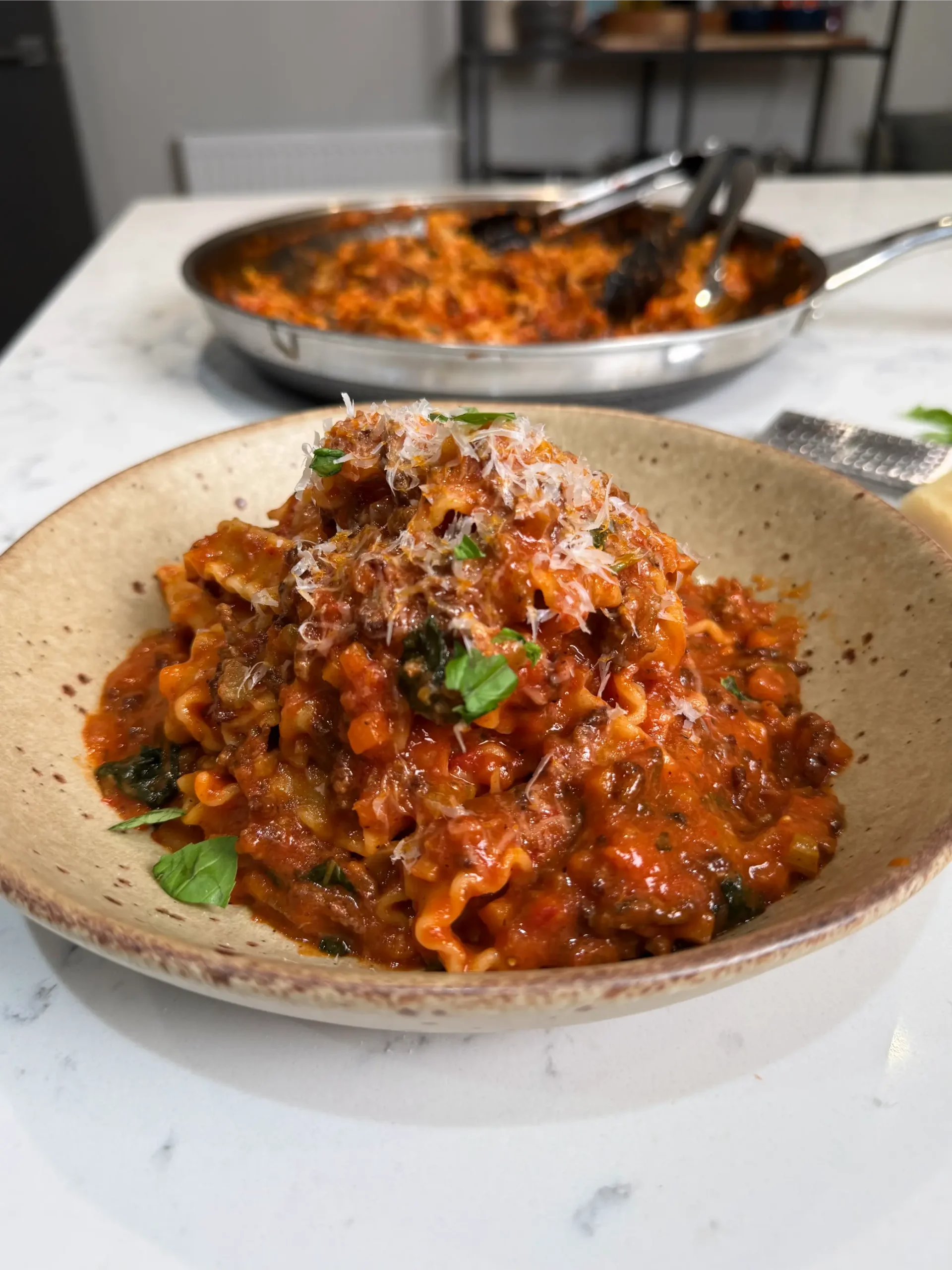
I used mafaldine, which is a long ribbon pasta with lovely ruffled edges.
It works brilliantly because those ridges catch loads of the Bolognese.
But you absolutely don’t need mafaldine to make this.
Tagliatelle or pappardelle would be great if you want another ribbon pasta.
Rigatoni is brilliant because the meat sauce gets trapped inside the tubes.
Penne, fusilli or even spaghetti will all work too.
And here’s my slightly random pasta-buying tip: TK Maxx is genuinely one of my favourite places to find good Italian pasta.
It sounds bizarre, but their food section often has proper imported Italian brands and unusual pasta shapes you rarely see in normal supermarkets. Mafaldine is exactly the sort of thing I often find there.
Whenever I’m in TK Maxx, I pretty much always check the pasta shelf.
Parmesan goes into the sauce, not just on top
Obviously, we’re finishing with Parmesan.
It’s Bolognese.
But I also add grated Parmesan directly to the pan before serving.
As you toss it through the hot pasta and sauce, the cheese melts and adds another layer of savoury richness.
Along with the pasta water, it also helps everything come together into that glossy finish.
Fresh basil goes in right at the end so it keeps its freshness rather than disappearing into the sauce during cooking.
What to serve with ’Nduja Bolognese
For me, this is already a complete dinner.
A big bowl of pasta, loads of Bolognese and extra Parmesan over the top.
Done.
If you’re feeding a crowd, garlic bread alongside is obviously going to go down well.
A simple rocket salad with lemon and olive oil is good if you want something fresh to cut through the richness.
And a bit of extra Parmesan and chilli on the table never hurts.
Can I make this less spicy?
Absolutely.
Different brands of ’nduja vary quite considerably in heat, so it’s worth tasting yours.
If you’re unsure, start with around 20 to 30g and add more if you want it.
You could also increase the beef and tomato slightly if you’re cooking for people who don’t enjoy much chilli.
On the other hand, if you want it hotter, add more ’nduja or a pinch of chilli flakes.
It’s an easy recipe to adjust.
Making this recipe in the US
There aren’t many changes needed to make this ’Nduja Bolognese in America, but there are a few useful ingredient translations.
200g pasta is approximately 7 oz pasta.
250g minced beef is approximately 9 oz ground beef. I’m using mince with around 10% fat; in the US, 90/10 ground beef would be a close equivalent.
40g ’nduja is approximately 1½ oz ’nduja.
2 tablespoons tomato paste is exactly the same measurement in the US.
1 x 400g tin finely chopped tomatoes is approximately one 14 oz can diced or crushed tomatoes. Finely crushed tomatoes will give you the closest texture.
200ml beef stock is approximately ¾ cup plus 1 tablespoon beef broth or beef stock.
30g Parmesan is roughly 1 oz Parmesan, plus extra for serving.
10g fresh basil is roughly ⅓ cup loosely packed basil leaves, although there’s absolutely no need to be overly precise with the herbs.
There are also a couple of terminology differences worth knowing.
What we call minced beef in Britain is ground beef in America, while a tin of tomatoes is normally described as a can of tomatoes.
’Nduja itself has the same name wherever you’re buying it.
If you’re searching for it in an American grocery store, look around the speciality Italian meats and deli section. You may also find it sold in jars.
Ingredients
200g pasta, I used mafaldine
250g minced beef (10%)
1 onion, diced
1 carrot, diced
1 stick celery, diced
3 garlic cloves, minced
40g ’nduja
2 tbsp tomato paste
1 tsp dried oregano
1 x 400g tin finely chopped tomatoes
200ml beef stock
10g basil, torn
30g Parmesan, grated, plus extra to serve
Method
- Heat some olive oil in a large frying pan over a high heat. Add the beef mince and cook until deeply browned, breaking it up as it cooks.
- Meanwhile, in a separate pan, cook the onion, carrot and celery for 8 to 10 minutes until softened. Add the garlic and cook for another minute.
- Add the ’nduja and tomato paste to the vegetables. Cook for 2 minutes until the ’nduja has melted and the tomato paste has darkened, then add everything to the browned minced beef.
- Pour in the chopped tomatoes and beef stock, then stir through the oregano. Bring to a gentle simmer and cook for 15 minutes, stirring occasionally, until the sauce has thickened.
- Meanwhile, bring a large pan of salted water to the boil and cook the pasta for 2 minutes less than the packet instructions.
- Reserve a mug of pasta water before draining. Add the pasta to the Bolognese with a splash of the reserved pasta water and toss until glossy and well coated.
- Add the grated Parmesan and fresh basil and toss everything together. Taste and adjust the seasoning if needed.
- Dish it up and finish with plenty more grated Parmesan.
Equipment
Large frying pan
Second frying pan or saucepan
Large saucepan for the pasta
Colander or pasta tongs
Sharp knife
Chopping board
Wooden spoon
Cheese grater
FAQs
What is ’nduja?
’Nduja is a spicy, spreadable pork salami originating from Calabria in southern Italy. It’s made with pork and chilli peppers and becomes soft and almost sauce-like when heated, making it particularly good for pasta dishes.
How spicy is ’nduja?
It has a noticeable chilli heat, although the exact spice level varies between brands. In this Bolognese, it’s balanced by the beef, tomatoes and Parmesan, so the finished dish is spicy without being overwhelmingly hot.
Can I make ’Nduja Bolognese without ’nduja?
Technically yes, but then you’ve basically made Bolognese! If you can’t find ’nduja but want a similar spicy pork flavour, you could experiment with a little spicy Italian sausage and chilli, although it won’t be exactly the same.
What is minced beef called in America?
Minced beef is called ground beef in the US. For this recipe, something around 90% lean and 10% fat works well.
Where can I buy ’nduja?
Most larger UK supermarkets now sell it, usually near the cured meats or speciality Italian ingredients. Italian delis are another good place to look. Depending on the brand, it can come as a sausage, in a packet or in a jar.
What pasta goes best with ’Nduja Bolognese?
Mafaldine, tagliatelle and pappardelle are all brilliant because the wide ribbons hold plenty of sauce. Rigatoni is another great choice, particularly if you prefer short pasta.
Can I make ’Nduja Bolognese ahead of time?
Yes. The Bolognese sauce can be made ahead and kept refrigerated for up to three days. I’d cook the pasta fresh and toss it through the reheated sauce just before serving.
Can I freeze ’Nduja Bolognese?
Yes. The meat sauce freezes really well. Let it cool completely, transfer it to an airtight container and freeze. I’d freeze the sauce without the pasta and cook fresh pasta when you’re ready to eat it.
Can I use pork mince instead of beef?
Yes. Pork mince works particularly well with ’nduja, although you’ll get a slightly different flavour. A mixture of beef and pork would also be delicious.
Why do you finish pasta in the sauce?
Finishing the pasta directly in the Bolognese allows it to absorb some of the sauce while releasing starch into the pan. Along with a splash of pasta water, this helps the sauce cling to the pasta rather than simply sitting on top.
Final thoughts
If you love a classic Bolognese but fancy changing things up, adding ’nduja is such an easy way to completely transform it.
You still get everything comforting about the original – browned beef, tomatoes, softened vegetables, pasta and loads of Parmesan – but running through it is that spicy, smoky richness from the ’nduja.
And despite tasting like something that’s been cooking for considerably longer, you can get it on the table quickly enough for a midweek dinner.
Brown the beef properly, give your soffritto time to soften, cook out the tomato paste and finish the pasta directly in the sauce with plenty of Parmesan.
Then all that’s left is another grating of cheese and getting stuck in.
’Nduja Bolognese
Ingredients
- 200 g pasta I used mafaldine
- 250 g minced beef 10%
- 1 onion diced
- 1 carrot diced
- 1 stick celery diced
- 3 garlic cloves minced
- 40 g ’Nduja
- 2 tbsp tomato paste
- 1 tsp dried oregano
- 1 x 400g tin finely chopped tomatoes
- 200 ml beef stock
- 10 g basil torn
- 30 g Parmesan grated, plus extra to serve
Instructions
- Heat some olive oil in a large frying pan over a high heat. Add the beef mince and cook until deeply browned, breaking it up as it cooks.
- Meanwhile, in a separate pan, cook the onion, carrot and celery for 8 to 10 minutes until softened, then add the garlic and cook for another minute.
- Add the ’nduja and tomato paste. Cook for 2 minutes until the ’nduja has melted and the tomato purée has darkened. Now add it into the browned minced beef.
- Pour in the chopped tomatoes and beef stock, then stir through the oregano. Bring to a gentle simmer and cook for 15 minutes, stirring occasionally, until the sauce has thickened.
- Meanwhile, bring a large pan of salted water to the boil and cook the pasta for 2 minutes less than the packet states.
- Reserve a mug of the pasta water before draining the pasta. Add the pasta to the sauce along with a splash of the reserved pasta water, tossing until glossy and well coated.
- Add the grated parmesan, and fresh basil and toss together. taste for seasoning.
- Dish it up, then finish with some more grated parmesan.