Perfect Easter Roast Leg of Lamb
There are certain meals that feel tied to a moment in the year. Christmas has turkey. Summer has barbecues. And Easter, for many people, is all about roast lamb. A beautifully cooked leg of lamb arriving at the table, crisp and golden on the outside, blushing pink in the middle, surrounded by the smell of garlic, rosemary and roasting meat. It’s the kind of centrepiece that brings everyone to the kitchen before it’s even carved.
This roast leg of lamb is exactly that kind of dish. Simple ingredients, classic flavours, and a method that lets the meat shine. Garlic pushed deep into the lamb, rosemary and lemon rubbed into the surface, Dijon mustard for a subtle savoury depth, and olive oil to help everything roast beautifully.
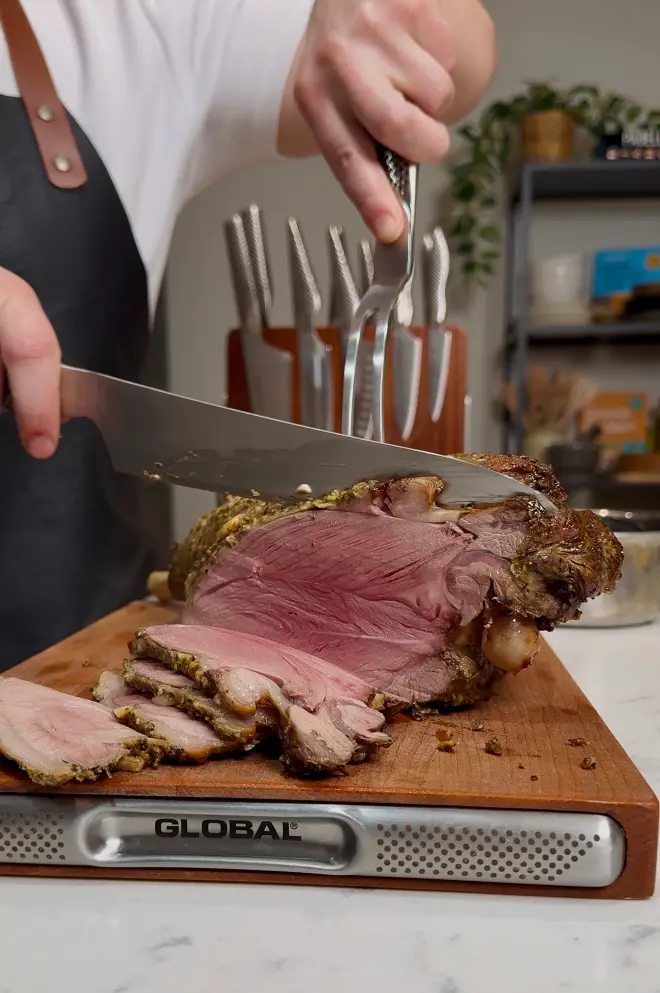
The result is a leg of lamb that’s crisp and flavourful on the outside while staying juicy and tender in the middle. When you slice into it after resting, the meat should be soft, pink and full of flavour, the kind of roast that makes everyone reach for another slice.
This recipe is also part of a special brand collaboration with Global Knives, which makes it even more meaningful to me personally. Global knives were the very first professional knives I bought when I started working as a chef. They’re incredibly sharp, beautifully balanced and built to last. I’ve used them in professional kitchens for years, so getting the chance to work with them on a recipe like this feels like a full-circle moment.
And if there’s ever a time to bring out a great carving knife, it’s when you’ve got a whole roast leg of lamb sitting on the board.
Perfect Easter Roast Leg of Lamb
A beautifully roasted leg of lamb studded with garlic and rosemary, crisp on the outside and juicy and blushing in the middle, perfect for carving at the table.
This is a classic Easter roast. Fragrant herbs, bright lemon, and tender lamb cooked until perfectly pink.
Why lamb is the traditional Easter roast
Lamb has long been associated with Easter across many cultures.
Historically, lamb symbolised spring and renewal, which makes sense when you consider that Easter falls during the time of year when lamb is naturally in season. Young spring lamb has a delicate flavour and tender texture that makes it perfect for roasting.
Over time, roast lamb became a centrepiece for Easter meals in many parts of Europe and beyond. It’s rich enough to feel celebratory but still simple enough to prepare at home.
Today, it remains one of the most popular dishes served at Easter gatherings.
The beauty of roasting a whole leg
Roasting a leg of lamb is one of those dishes that looks impressive but is actually very straightforward.
Unlike more complicated cuts of meat that require constant attention, a leg of lamb mostly cooks itself once it’s in the oven. The key is simply seasoning it properly, starting it in a hot oven to develop colour, and then letting it roast gently until it reaches the perfect internal temperature.
Because the cut is large, it stays juicy even when roasted for over an hour. And when carved thinly across the grain, the meat becomes incredibly tender.
Garlic and rosemary: a classic pairing
Garlic and rosemary are probably the most traditional flavours to use with lamb.
Rosemary has a bold, pine-like aroma that complements the richness of lamb beautifully. Garlic adds warmth and depth, especially when it slowly roasts inside the meat.
By making small incisions in the lamb and pushing slices of garlic directly into the cuts, the flavour gets right into the meat rather than just sitting on the surface.
As the lamb cooks, the garlic softens and perfumes the meat from within.
Lemon zest brightens the flavour
Lamb is naturally rich, so adding something fresh and bright helps balance it.
Lemon zest does exactly that. It adds a subtle citrus fragrance that cuts through the richness without making the dish taste overly acidic.
Combined with rosemary and garlic, it creates a flavour profile that feels fresh, aromatic and perfectly suited to spring.
Dijon mustard adds depth
Dijon mustard might seem like a small addition, but it adds a lot of subtle complexity.
It brings a gentle tang and savoury note that enhances the lamb without overpowering it. When rubbed into the surface of the meat along with olive oil and herbs, it helps form a flavourful crust during roasting.
It’s one of those ingredients that works quietly in the background, but you’d miss it if it wasn’t there.
Starting hot for the perfect crust
The first stage of roasting happens at a high temperature.
This initial blast of heat helps brown the outside of the lamb quickly, creating a caramelised crust that adds flavour and texture. Once that colour has developed, the oven temperature is lowered so the meat can cook gently without drying out.
This two-stage roasting method is the secret to achieving lamb that’s both crispy on the outside and juicy in the middle.
Cooking lamb to the perfect doneness
Lamb is best when cooked to medium-rare or medium.
At around 55–60°C internal temperature, the meat stays pink, tender and juicy. Cooking it beyond that can make it firmer and less succulent.
Using a meat thermometer takes the guesswork out of roasting. It ensures the lamb reaches the ideal doneness every time.
The importance of resting
Resting the lamb after roasting is one of the most important steps.
When meat cooks, the juices move toward the centre. If you carve it immediately, those juices will run out onto the board. Letting the lamb rest for around 20 minutes allows the juices to redistribute throughout the meat.
The result is slices that stay moist and flavourful.
Using great knives makes a difference
Carving a roast properly requires a sharp knife.
For this recipe I used Global knives, which I’ve personally relied on for years in professional kitchens. They were the first knives I invested in when I started working as a chef, and they’re still some of the best tools I own.
Their sharpness and balance make carving clean, even slices effortless, which is exactly what you want when serving a beautiful roast like this.
Ingredients
2–2.5 kg leg of lamb
4 cloves garlic, sliced
10 g rosemary, finely chopped
Zest of 1 lemon
2 tbsp Dijon mustard
3 tbsp olive oil
Salt and black pepper
1 onion, roughly chopped
Method
-
Take the lamb out of the fridge 1 hour before cooking so it comes up to room temperature.
-
Preheat the oven to 220°C / 200°C fan.
-
Using a sharp knife, make small incisions all over the lamb.
-
Push the slices of garlic into the cuts.
-
In a small bowl mix the rosemary, lemon zest, Dijon mustard, olive oil, salt and black pepper.
-
Rub this mixture all over the lamb, pushing it into the cuts so the flavour gets deep into the meat.
-
Scatter the chopped onion in a roasting tray and sit the lamb on top.
-
Roast for 20 minutes to brown the outside.
-
Turn the oven down to 180°C / 160°C fan and roast for another 50–60 minutes for pink lamb.
-
Transfer the lamb to a board and let it rest for at least 20 minutes before carving.
What to serve with roast lamb
Roast lamb pairs beautifully with classic Easter sides.
Roast potatoes or fondant potatoes
Honey roasted carrots
Spring greens or asparagus
Mint sauce or mint chimichurri
A rich lamb gravy made from the roasting juices
These simple sides allow the lamb to remain the star of the plate.
Final thoughts
A roast leg of lamb is one of those dishes that never goes out of style.
It’s simple, comforting and perfect for bringing people together around the table. With garlic, rosemary, lemon and mustard, the flavours feel classic but fresh enough for spring.
Whether you’re cooking for a big Easter gathering or a relaxed Sunday roast, this recipe delivers everything you want from a great roast.
Crisp outside. Juicy inside. Beautiful slices of lamb ready to carve.
And with the right knife in hand, it’s even more satisfying.