

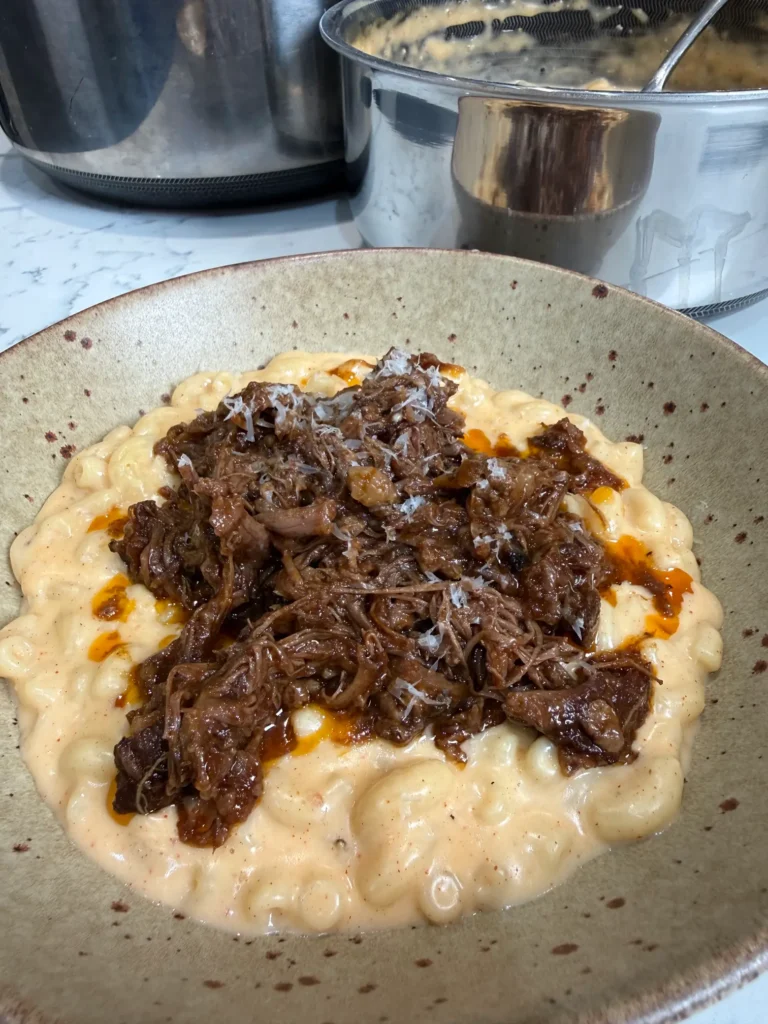
This Sticky Beef Short Rib Mac & Cheese is comfort food taken to a completely different level.
You’ve got ridiculously creamy mac and cheese made with mature Cheddar and Parmesan, then piled high with beef short ribs that have been slowly cooked for three hours in red wine, beef stock, soy sauce, garlic and tomato until they’re completely falling apart.
Once the beef is tender, the cooking liquid gets reduced right down until it’s dark, rich and glossy, then the shredded beef goes back through it.
That sticky beef spooned over creamy, cheesy macaroni is ridiculous.
This obviously isn’t one of my usual speedy midweek recipes. You’re looking at around three hours for the short ribs, but most of that time they’re just sitting in the oven doing their thing.
And if you’re going to spend three hours slow-cooking something, you might as well make it worth it.
This one definitely is.
Why beef short ribs are perfect for slow cooking
Short ribs are one of my favourite cuts when I want properly tender, fall-apart beef.
They’re naturally rich and contain plenty of connective tissue and fat. Cook them quickly and they can be tough, but give them a few hours of gentle heat and everything begins to break down.
Collagen in the connective tissue converts into gelatin during slow cooking, which is a big part of what gives both the meat and sauce that rich, almost sticky texture.
That’s why short ribs are so good for braising.
After around three hours at 160°C, you should barely need to do anything to them. The meat should pull away from the bones incredibly easily.
If you’re having to fight with the beef to shred it, give it longer.
Tenderness is more important than sticking religiously to the clock.
Brown the short ribs properly
Before anything gets slow cooked, get some serious colour onto those ribs.
Season them generously with salt and black pepper, get a frying pan properly hot and brown them really well on every side.
Don’t rush this stage.
Browning creates hundreds of new flavour compounds through the Maillard reaction, giving you much deeper savoury flavours than you’d get by simply dropping raw beef into the braising liquid.
You want dark brown.
Not grey.
And because you’re working with 1.4kg of short ribs, cook them in batches if necessary. Overcrowding the pan drops the temperature and causes the beef to steam rather than sear.
A few extra minutes here makes a massive difference to the final sauce.
Why I cook the onions separately
While the beef is browning, I start the onion in the casserole dish.
That saves a bit of time and means both parts can cook properly.
The onion gets four or five minutes to soften before the garlic and tomato paste go in.
Again, we’re building flavour in stages rather than throwing everything into one pot and hoping for the best.
Once the garlic and tomato have cooked for another minute, you’re ready for the liquid.
Red wine makes an incredible short rib sauce
There’s 200ml of red wine in the braising liquid alongside 400ml beef stock, soy sauce and tomato paste.
The wine brings acidity and depth that works brilliantly with rich beef.
You don’t need to use an expensive bottle.
A dry red you’d happily drink is absolutely fine.
Merlot, Cabernet Sauvignon, Malbec or a Côtes du Rhône-style wine would all work.
Avoid anything extremely sweet.
And if you’d rather make it without alcohol, you can replace the wine with additional beef stock and add a small splash of balsamic or red wine vinegar for some acidity.
It won’t taste exactly the same, but you’ll still end up with a brilliant braised beef sauce.
Why there’s soy sauce in the beef
A tablespoon of soy sauce might seem slightly random in a beef short rib recipe like this, but it makes complete sense.
Soy sauce is packed with savoury, umami flavour.
You’re not adding enough to make the beef taste strongly of soy. It’s there in the background, boosting the beefiness of the whole sauce.
It’s basically another form of seasoning.
Just remember that both the beef stock and soy sauce contain salt, so taste the reduced sauce before adding any extra.
Do the short ribs need to be completely submerged?
No.
This is braising rather than boiling.
The short ribs don’t need to be completely underwater for the recipe to work, particularly because the casserole dish is covered with a lid while they’re in the oven.
The enclosed environment traps steam while the lower parts of the ribs cook in the braising liquid.
If they’re particularly exposed, you can turn them during cooking, but you don’t need to drown them in stock.
In fact, adding loads of unnecessary liquid just means you’ll have much more to reduce at the end.
Why 160°C works so well
Low and slow is what we’re after.
At 160°C, the short ribs get enough heat to gently braise while giving all that collagen time to break down.
The casserole dish stays covered, helping retain moisture during the three-hour cook.
You don’t want a violently boiling pan of beef.
Gentle cooking gives you a much better texture.
Reducing the sauce is the important bit
When the beef comes out of the oven, the liquid probably won’t look like the finished sauce yet.
That’s completely normal.
Take the short ribs out first, then put the casserole dish over a high heat and let that liquid bubble.
As water evaporates, all the beef, wine, stock, tomato, garlic and soy flavours become more concentrated.
The sauce becomes darker.
Thicker.
Glossier.
Eventually you get something rich enough to cling to the shredded beef rather than running straight off it.
Don’t skip this step.
It’s what takes the beef from ordinary braised short ribs to sticky beef short ribs.
Remove the bones before shredding
After three hours, the bones should pull away easily.
Remove them along with any large pieces of excess fat you don’t want in the finished dish, then shred the beef into chunky pieces.
I wouldn’t completely pulverise it.
You want proper pieces of pulled short rib running through that sticky sauce.
Once the sauce has reduced, stir the shredded meat back through and keep it warm while you make the mac and cheese.
Try not to eat half of it directly from the casserole dish.
The easiest way to make cheese sauce
The mac and cheese uses a really simple all-in-one method.
Rather than melting the butter, adding flour, gradually whisking in milk and making a traditional roux-based béchamel in separate stages, the butter, flour, milk, garlic granules and smoked paprika all go into the saucepan together.
Then you whisk continuously over a medium heat.
As the butter melts and everything heats up, the flour thickens the milk into a smooth sauce.
It’s straightforward and saves messing around.
The key is whisking.
Keep everything moving, particularly as the sauce starts to thicken, so you don’t end up with floury lumps or sauce catching on the bottom of the pan.
Garlic and smoked paprika in mac and cheese
Mac and cheese can handle plenty of flavour.
A teaspoon each of garlic granules and smoked paprika goes into the white sauce.
The garlic adds another savoury layer, while the smoked paprika works particularly well because we’re serving the mac with that rich slow-cooked beef.
It also gives the cheese sauce a slightly warmer colour.
Neither should overpower the cheese.
They’re just there in the background making everything taste better.
Mature Cheddar and Parmesan
For the cheese, I’m using 250g mature Cheddar and 80g Parmesan.
Cheddar gives you the classic mac and cheese flavour and that rich creaminess.
Parmesan brings saltiness, nuttiness and loads of umami.
Together they’re much more interesting than using Cheddar alone.
Take the white sauce off the heat before stirring in the cheese.
You only need the residual heat to melt finely grated cheese, and avoiding aggressive boiling reduces the chance of your cheese sauce becoming grainy or oily.
Don’t make your cheese sauce too thick
Remember that mac and cheese continues to thicken as it sits.
The starch in the pasta, flour in the sauce and melted cheese all contribute to that.
You want the sauce thick enough to coat the macaroni but still loose and creamy.
If it becomes too thick, add a splash of milk.
Particularly with this recipe, I want really creamy mac underneath that sticky beef.
Dry mac and cheese isn’t invited.
Why macaroni works so well
Sometimes the obvious pasta choice is the right one.
Macaroni has all those little curved tubes for cheese sauce to work its way into, giving you sauce inside and outside the pasta.
That makes every mouthful properly cheesy.
You could use another short pasta shape if that’s what you’ve got – cavatappi, rigatoni or shells would all be great – but classic macaroni is difficult to beat.
Don’t mix the beef into the mac and cheese
You could stir the shredded beef through the macaroni.
But I much prefer piling it over the top.
You get a proper contrast between the creamy, cheesy pasta and that dark, sticky beef.
Then when you start eating, you can drag pieces of beef and sauce down through the mac.
It looks considerably better too.
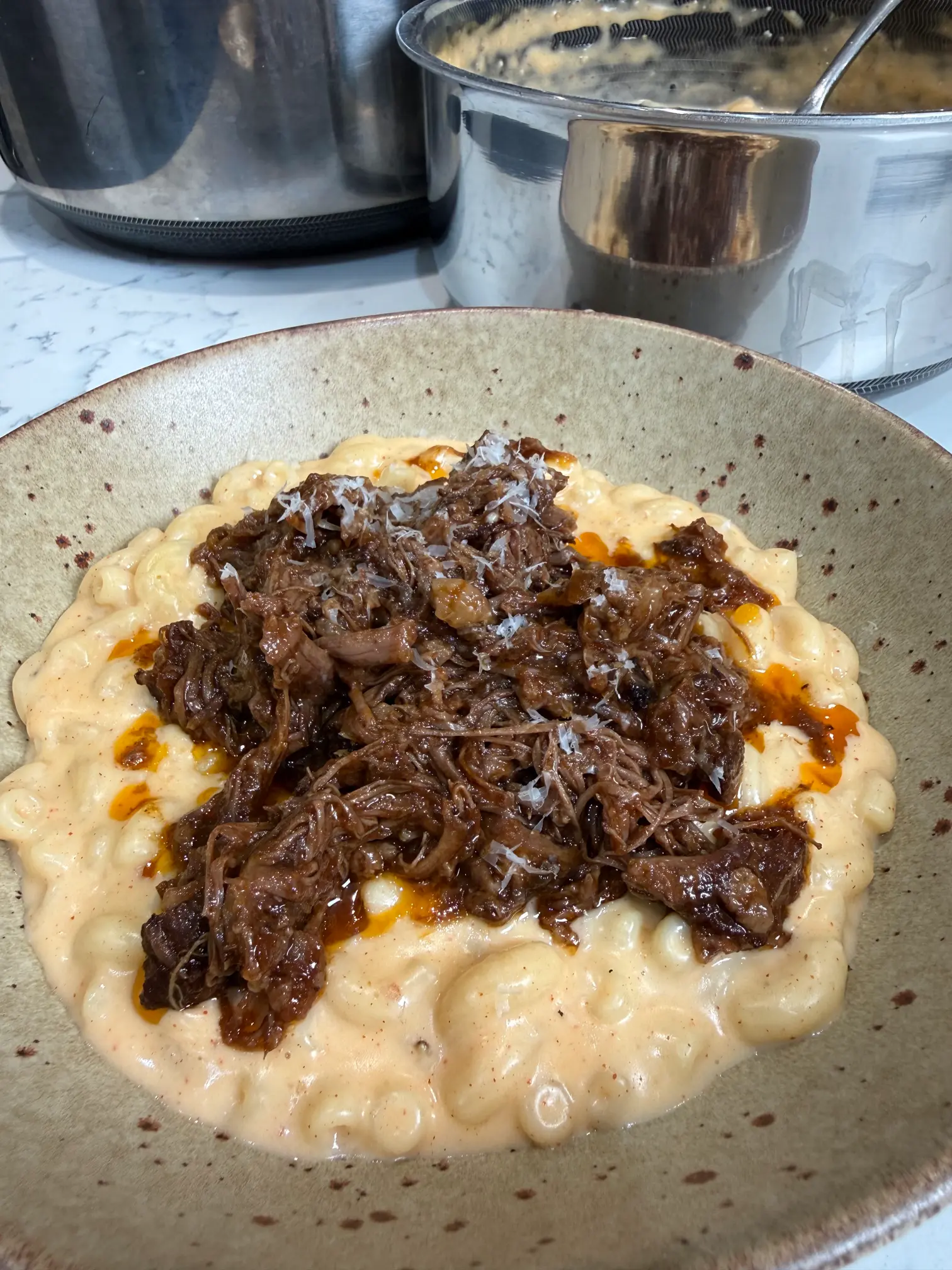
A bowl of pale golden mac and cheese with glossy short rib piled over it is exactly how I want this served.
Can I make the sticky beef ahead?
Absolutely, and this is probably the best way to turn this into an easier dinner.
Make the short ribs the day before.
Shred the beef, reduce the sauce and combine everything, then allow it to cool and refrigerate.
The next day, gently reheat the beef while you cook the macaroni and make the cheese sauce.
Slow-cooked dishes often taste even better after a night in the fridge because all those flavours have had time to sit together.
It also means you’re only about 20 minutes away from dinner.
What to serve with Sticky Beef Short Rib Mac & Cheese
This isn’t exactly a meal crying out for another carbohydrate.
It’s rich.
Very rich.
So I’d go with something green and fresh alongside it.
Tenderstem broccoli would be brilliant.
Green beans work well.
A simple green salad with a sharp vinaigrette is probably even better because the acidity cuts through all that cheese and slow-cooked beef.
But if we’re being realistic, I’d also happily put a massive bowl of this in front of me with absolutely nothing else.
Making this recipe in the US
If you’re making this Sticky Beef Short Rib Mac & Cheese in America, most of the ingredients are straightforward, but there are a few useful conversions and terminology differences.
1.4kg beef short ribs is approximately 3 lb beef short ribs.
200ml red wine is approximately ¾ cup plus 1 tablespoon red wine.
400ml beef stock is approximately 1⅔ cups beef broth or beef stock.
400g macaroni is approximately 14 oz elbow macaroni.
50g butter is approximately 3½ tablespoons butter.
50g plain flour is approximately ⅓ cup plus 1 tablespoon all-purpose flour. British plain flour is called all-purpose flour in the US.
600ml whole milk is approximately 2½ cups whole milk.
250g mature Cheddar is approximately 9 oz sharp Cheddar cheese. Mature Cheddar is generally labelled sharp or extra-sharp Cheddar in America.
80g Parmesan is approximately 3 oz Parmesan.
For the oven, 160°C is approximately 320°F. In a US oven, 325°F is perfect for this recipe.
British macaroni is essentially the same as American elbow macaroni, so there’s no major change there.
Ingredients
For the sticky beef
1.4kg beef short ribs
1 onion, diced
3 cloves garlic, minced
2 tbsp tomato paste
1 tbsp soy sauce
200ml red wine
400ml beef stock
For the mac & cheese
400g macaroni
50g butter
50g plain flour
600ml whole milk
1 tsp garlic granules
1 tsp smoked paprika
250g mature Cheddar, grated
80g Parmesan, grated
Method
- Preheat the oven to 160°C.
- Season the beef short ribs with salt and black pepper. Heat a little oil in a large frying pan over a high heat, then brown the ribs really well on all sides. Remove and set aside.
- Meanwhile, heat a little oil in a large ovenproof casserole dish over a medium heat. Add the onion and cook for 4–5 minutes until softened, then add the garlic and tomato paste and cook for another minute.
- Pour in the red wine, beef stock and soy sauce. Add the browned short ribs to the casserole dish and bring everything to a simmer.
- Put the lid on and cook in the oven for around 3 hours, until the beef is tender and falling away from the bones.
- Take the ribs out and pull the meat away from the bones. Put the sauce over a high heat and let it bubble until it reduces into a rich, glossy sauce. Shred the beef, stir it back through the sauce and keep warm.
- Cook the macaroni in salted boiling water according to the packet instructions, then drain.
- Add the butter, flour, milk, garlic granules and smoked paprika to a large saucepan. Place over a medium heat and whisk continuously until the butter has melted and the sauce is smooth and thickened.
- Take the sauce off the heat, then stir in the Cheddar and Parmesan until melted and smooth. Season to taste with salt and black pepper.
- Stir the macaroni through the cheese sauce until completely coated. If it’s a little too thick, loosen it with a splash of milk.
- Spoon the creamy mac and cheese into bowls, pile the sticky pulled short rib beef over the top and finish with a little extra Parmesan if you like.
Equipment
Large ovenproof casserole dish with a lid
Large frying pan
Large saucepan
Second saucepan for the macaroni
Whisk
Wooden spoon
Colander
Cheese grater
Sharp knife
Chopping board
Two forks for shredding the beef
FAQs
What are beef short ribs?
Beef short ribs come from the rib area of the cow and contain plenty of meat, fat and connective tissue. That makes them particularly well suited to slow cooking, where they become incredibly tender.
How long do beef short ribs take to become tender?
For this recipe, allow around three hours at 160°C. The exact time can vary depending on the size of the ribs. Use tenderness rather than the clock as your final test – the meat should pull easily away from the bones.
Do short ribs need to be submerged in liquid?
No. When braising short ribs in a covered casserole dish, they don’t need to be completely submerged. The combination of braising liquid and trapped steam keeps them moist while they cook.
Why are my beef short ribs still tough after three hours?
They probably need longer. Tough short ribs usually haven’t cooked for enough time for the connective tissue to properly break down. Put the lid back on and continue cooking, checking them periodically.
Can I make Sticky Beef Short Rib Mac & Cheese ahead of time?
Yes. I’d make the sticky short rib beef ahead rather than the finished mac and cheese. Refrigerate the beef in its sauce, then gently reheat it while making the macaroni fresh.
Can I make this without red wine?
Yes. Replace the wine with additional beef stock and consider adding a small splash of balsamic or red wine vinegar to bring back some acidity.
What cheese is best for mac and cheese?
Mature Cheddar gives you that classic strong cheese flavour, while Parmesan adds saltiness and umami. Using the two together gives this sauce much more depth.
What is mature Cheddar called in America?
Sharp Cheddar is the closest US equivalent. If you like a particularly strong cheese flavour, use extra-sharp Cheddar.
Can I freeze the short rib beef?
Yes. The shredded beef and reduced sauce should freeze well. Cool completely before transferring to a suitable airtight container. Defrost thoroughly in the fridge and reheat until piping hot.
Can I freeze the finished mac and cheese?
You can, but the texture of cheese sauce is generally better freshly made. For the best result, freeze the beef separately and make fresh mac and cheese when you’re ready to serve.
How do I make my mac and cheese creamier?
Don’t let the white sauce become excessively thick before adding the cheese, and loosen the finished mac with a splash of milk if necessary. It should look slightly looser in the pan because it’ll thicken as it cools.
Can I use boneless short ribs?
Yes, if you can find them. Bone-in short ribs are brilliant for braising and the bones contribute to the richness of the cooking liquid, but boneless short ribs can still work well.
Final thoughts
This Sticky Beef Short Rib Mac & Cheese is not subtle food.
It’s a massive bowl of creamy Cheddar and Parmesan mac topped with slow-cooked beef that’s been sitting in red wine and beef stock for hours before being shredded through its own sticky, reduced sauce.
And that’s exactly why it’s so good.
The individual techniques are actually pretty simple. Brown the beef properly. Give it enough time in the oven to become completely tender. Reduce the braising liquid until it’s rich and glossy. Then keep your mac and cheese loose, silky and properly cheesy.
Put the two together and you’ve got serious comfort food.
It’s definitely one for a weekend rather than a rushed Tuesday night.
But when you’ve got the time, it’s absolutely worth it.
Sticky Beef Short Rib Mac & Cheese
Ingredients
For the sticky beef:
- 1.4 kg beef short ribs
- 1 onion diced
- 3 cloves of garlic minced
- 2 tbsp tomato paste
- 1 tbsp soy sauce
- 200 ml red wine
- 400 ml beef stock
For the mac & cheese:
- 400 g macaroni
- 50 g butter
- 50 g plain flour
- 600 ml whole milk
- 1 tsp garlic granules
- 1 tsp smoked paprika
- 250 g mature Cheddar grated
- 80 g Parmesan grated
Instructions
- Preheat the oven to 160℃.
- Season the beef short ribs with salt and black pepper. Heat a little oil in a large frying pan over a high heat, then brown the ribs really well on all sides. Take them out and set aside.
- Meanwhile, heat a little oil in a large ovenproof casserole dish over a medium heat. Add the onion and cook for 4-5 minutes until softened, then add the garlic and tomato paste and cook for another minute.
- Pour in the red wine, beef stock and soy sauce. Add the browned short ribs to the casserole dish and bring it to a simmer.
- Pop the lid on and cook in the oven for about 3 hours, until the beef is tender and falling away from the bones.
- Take the ribs out and pull the meat away from the bones. Put the sauce over a high heat and let it bubble until it reduces into a rich, glossy sauce. Shred the beef, stir it back through the sauce and keep it warm.
- Cook the macaroni in salted boiling water according to the packet instructions, then drain it.
- Add the butter, flour, milk, garlic granules and smoked paprika to a large saucepan. Place it over a medium heat and whisk continuously until the butter has melted and the sauce is smooth and thickened.
- Take it off the heat, then stir in the Cheddar and Parmesan until melted and smooth. Season to taste with salt and black pepper.
- Stir the macaroni through the cheese sauce until completely coated. If it’s a little too thick, loosen it with a splash of milk.
- Spoon the creamy mac and cheese into bowls, then pile the sticky pulled short rib beef over the top. Finish with a little extra Parmesan if you like.